
Custom CNC machining services at Hongqian mean metal parts cut to your drawing on our own floor: bar stock, a red-punched forging or an investment casting in, finished part out, with the thread, the coating and the paperwork the drawing calls for. We are not a broker and not a job shop for one-offs. The business is built on repeat production lots for OEM buyers — mostly automotive and industrial components, quoted from the print and shipped on schedule, batch after batch.
Hongqian is a manufacturer, not a trading office: turning, forging, secondary operations and inspection sit on one site, so the answer on tolerance and the answer on lead time come from the same people. Plating is the one step we do not claim as our own — it is a controlled subcontract, and the coating thickness reading and the salt spray coupon still ship with the batch, so there is one report pack and one party answerable for it.
Two questions decide most enquiries, and both have straight answers on this page. What can you actually hold tolerance on, batch after batch — that is the equipment and the inspection section. And what does a first order cost me before I see a part — that is the MOQ and tooling section, including when a die is needed and when it is not.
Who this page fits — and who it does not
This is a production workshop, not a walk-in counter. If you are searching for a cnc shop near you for a same-day repair or two brackets by Friday, a local job shop is genuinely the right answer, and no overseas supplier beats drive-in pickup. Where we fit is different: custom machining buyers with a drawing, a quantity that starts at 1,000 pieces for bar-turned parts (3,000 where a die is involved), and a need for the same part to come out the same way every month. If that is your situation, the sections below show what the shop runs and what ships with a batch.
CNC turning: the core of the shop
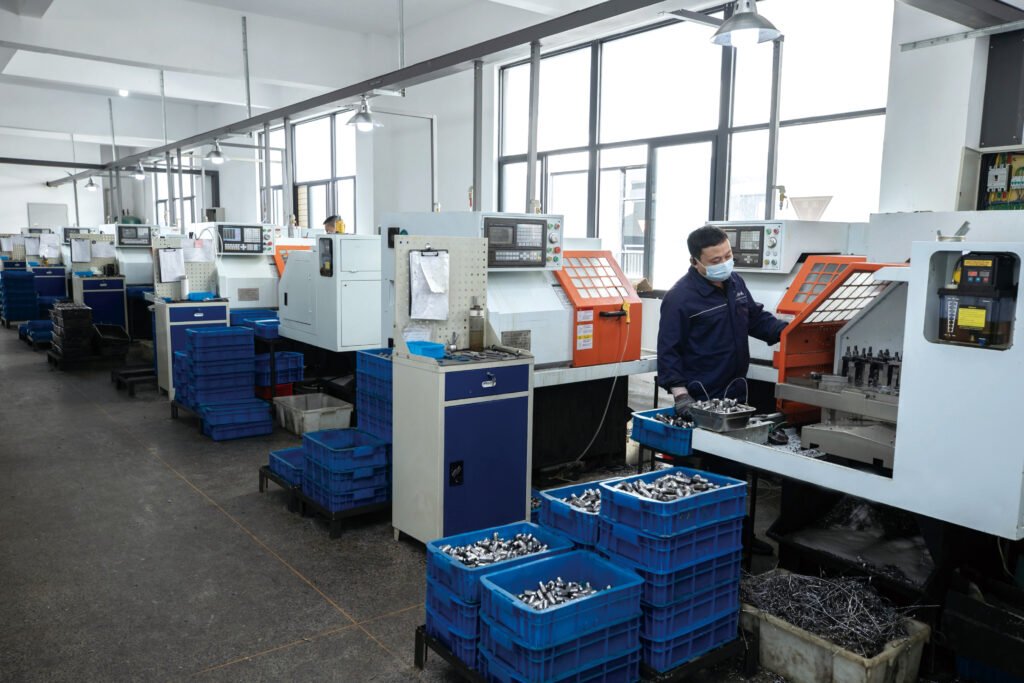
Our CNC turning services run on more than 60 CNC automatic lathes equipped with gantry-robot loading lines and internal expansion collets, with live tooling for milling, drilling and tapping in the same setup. Small, high-volume preforms and short blanks feed through vibratory bowls instead of the gantry lines, which is how a 40-gram fitting stays economic at quantity. Bar and tube stock are cut on our own automatic sawing and cutting machines, so blank length and face squareness are controlled in-house rather than bought in.
Because turning and forging sit under one roof — and because the turning line is where most of the custom CNC machining hours on a fitting actually go — the blank and the machining are quoted as one chain, not two suppliers pointing at each other. Small batches run from bar or tube stock to avoid tooling entirely and start at a lower minimum; when a drawing needs a
Milling and secondary operations, without a second freight bill
Live tooling covers milling, drilling and threading on the lathe itself. Beyond that, the same workshop carries presses, tapping machines, grinding machines, laser marking and ultrasonic cleaning, so a batch that needs a cross-hole, a stamped feature or a marked logo does not travel between vendors between operations. Every extra vendor in a chain is a tolerance hand-off and a delay you did not quote for; removing them is most of the reason buyers consolidate into one machining services partner instead of splitting the routing.
Metal choices: carbon steel, stainless and 42CrMo
| Material | Typical parts | Finishing we run with it |
|---|---|---|
| Carbon steel — 1020, 1045, 12L14, 1215, Q235B | Screw plugs, elbow connectors, brackets, threaded fittings | Zinc plating, blue-white or colour (yellow) etc. |
| Stainless — 304/304L, 316/316L | Investment-cast elbows, machined fittings, sensor parts | Acid pickling and passivation for castings |
| Alloy steel — 42CrMo (42CrMo4 / AISI 4140) | Automotive components, high-strength shafts and housings | Electroless nickel with post-plate bake |
All of it is metal CNC machining from ferrous bar, forging or casting — we do not quote aluminium or plastics, and saying so up front saves both sides a wasted drawing.
Finishing and salt spray, stated honestly
Zinc-plated carbon steel parts are salt spray tested from 24 to 240 hours, with 96 hours the typical callout on automotive drawings. Electroless nickel on 42CrMo is a different story: sealed, it lands anywhere from 48 to 240 hours, and because the coating has pores, the result is a distribution rather than a per-part guarantee — the honest way to buy it is a test coupon from your batch, tested and reported. The full reasoning is on the 42CrMo electroless nickel page; this page just refuses to promise what the chemistry cannot.
MOQ, tooling and lead time
| Route | Minimum | Tooling |
|---|---|---|
| Bar stock turning | 1,000 pcs per size | None |
| Red-punched (hot-forged) blank | 3,000 pcs per size | Die, one-time; 15–20 days |
| Investment casting | 3,000 pcs per size | Wax die, one-time; about 40 days to blank |
| Cold heading | 50,000 pcs | Die, one-time |
Samples come off the new die, not off a shelf: 15–20 days tooling plus 7–10 days first samples, about four weeks to your hand. The die is kept against your part number and rebuilt free of charge for life if it wears or breaks. From roughly 10,000 pieces the die charge is normally absorbed into the piece price rather than invoiced — the exact threshold depends on part size.
How a quote is built, and why the minimum is arithmetic rather than policy
A custom CNC machining quote is four numbers stacked: material, cycle time, tooling and finishing. Material is bar weight times grade price, plus the bar end you lose per cut. Cycle time is minutes per piece times the machine rate — on an automatic lathe with gantry loading a small fitting runs in seconds, which is why piece price collapses at volume and why a hundred pieces costs almost the same per unit as ten. Tooling is the one-time line. Finishing is priced by weight for zinc and by fixtured area for electroless nickel.
For the die-based routes the 3,000 minimum is what happens when the tooling line is divided by quantity. On a 3,000-piece order a die adds a few cents to each part and nobody notices. On a 300-piece order the same die adds several yuan per part, and the quote stops looking like a quote for a screw plug and starts looking like a quote for a machined instrument. We could send that number. It would be honest and it would be useless, so the answer is usually the bar-stock route instead — no die, a 1,000-piece floor per size, higher piece price, order accepted today.
Tolerance, thread and the repeatability question
Dimensional tolerances follow your drawing; where the drawing is silent we work to ISO 2768-m and say so on the quotation, because an unstated tolerance is the most common reason a first batch gets argued about at goods-in. Threads are cut and then gauged with Go/No-Go gauges — 6H for internal, 6g for external — and the gauge is the acceptance, not the operator’s judgement.
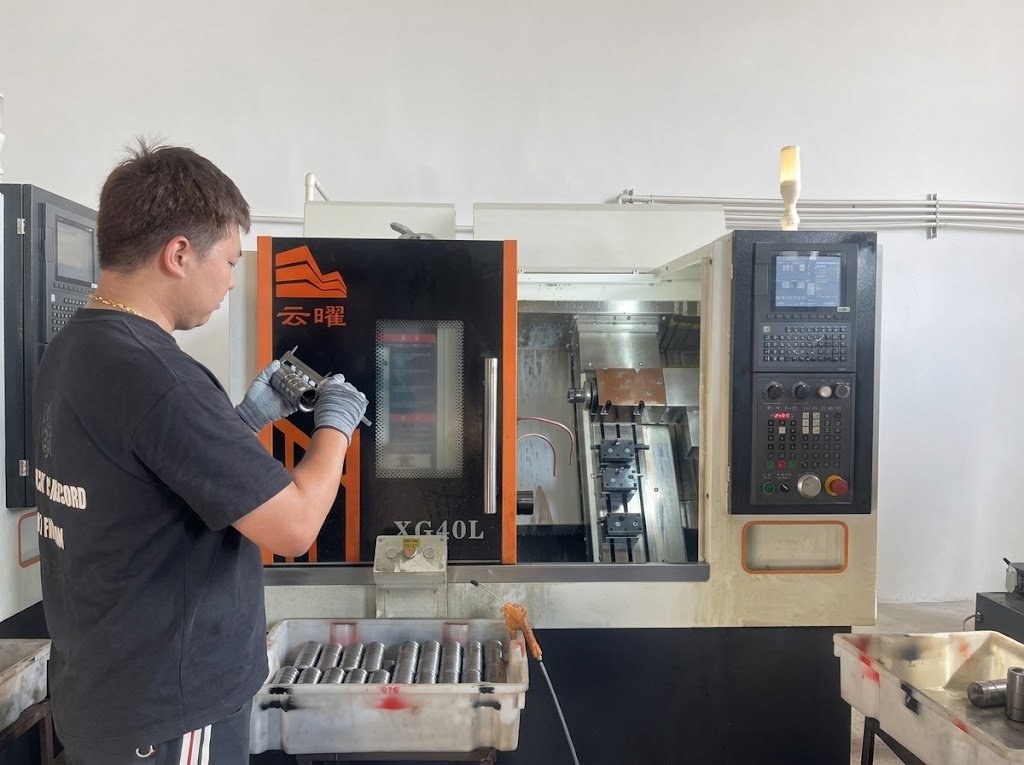
Repeatability on CNC machining parts comes from the machine and the tool-life schedule, not from an inspector catching bad pieces at the end. Tool changes are logged, the first part after each change is measured, and in-process checks run on a fixed interval through the shift. That is also why plating has to be quoted with the machining: a normal 2–5 µm deposit grows a thread pitch diameter by 4–10 µm, and a heavy 20 µm deposit grows it by about 40 µm — the point at which a 6g thread cut to nominal stops entering a 6H nut after plating. The allowance has to be cut into the part before the tank, and that decision belongs in the same conversation as the turning.
Inspection, and what ships with the batch
Operators run scheduled in-process checks and log dimensions during the shift, so drift is caught at the machine rather than after packing. The lab carries an optical projector, hardness testers and a surface roughness tester. Each batch ships with a dimensional inspection report and a material report for the heat; plated batches add the coating thickness reading and, where a strength class is specified, the post-plate bake record.
Frequently asked questions
01Are you a factory or a trading company?
A factory. Turning, forging, secondary operations and inspection run on one site in Yuhuan, Zhejiang — more than 60 CNC automatic lathes on gantry-robot loading lines, our own sawing and cutting, presses, tapping and grinding machines, laser marking and ultrasonic cleaning. Plating is the one step we do not claim as our own: it is a controlled subcontract, and the batch still ships with the coating thickness reading and the salt spray coupon result, so there is one report pack and one party responsible for it.
02Can I order less than 1,000 pieces?
Bar-stock turning starts at 1,000 pieces per size, and that is the floor most custom fittings land on. The other routes carry their own minimums because the tooling line is divided by quantity: red-punching and investment casting from 3,000 pieces, cold heading from 50,000. On 300 pieces a die cost per part stops looking like a fitting and starts looking like an instrument, so the honest quote is the bar-stock route at a higher unit price rather than a die spread over too few parts.
03Is the die charge one-time, and what happens when the die wears out?
One-time per part number, and free of charge for life — if the die wears or breaks in production, we rebuild it at our cost. The same part number never carries a second tooling charge, however many years later the reorder comes.
04Do you machine aluminium or plastics?
No. We machine ferrous metal only — carbon steel, stainless and alloy steel such as 42CrMo. Saying so up front saves both sides a drawing that goes nowhere.
05What tolerance can you hold?
The drawing governs. Where the drawing is silent we work to ISO 2768-m and state that on the quotation, because an unstated tolerance is the most common reason a first batch gets argued about at goods-in. Threads are gauged with Go/No-Go — 6H internal, 6g external — and the gauge is the acceptance, not the operator's judgement.
06Does plating change the dimensions?
Yes, but usually by less than people expect — and the allowance is decided at the lathe, not in the tank. Normal plating runs 2 to 5 micron per surface. On a thread that grows the pitch diameter by 4 to 10 micron, which most 6H nuts will still take, but we cut to suit it rather than rely on that. Heavy deposits are the case that actually bites. At 20 micron per surface — the top of what we plate, and only where the drawing asks for it — the pitch diameter grows by about 40 micron, and a 6g thread cut to nominal will not enter a 6H nut at all. So tell us the coating thickness with the drawing. The allowance is cut into the part before the tank, which is why coating and machining are quoted together rather than one added on top of the other.
07How long from drawing to first shipment?
It depends on the route. Bar-stock turning needs no die, so the first article lands one to two weeks after drawing approval. Routes that need a die — red-punching, investment casting, cold heading — run 15-20 days for tooling plus 7-10 days for first samples, about four weeks to your hand. Investment casting adds about 40 days to the cast blank before machining. Repeat orders skip the die stage entirely.
08What do you need to quote?
Four things: the drawing (PDF or STEP), the material grade, the thread callout and the coating spec, plus the first-lot quantity. A photo of a similar part is a start but not a quote — acceptance on this shop is by print.