
NPT fittings and NPTF fittings look the same on the shelf. Same 60° thread. Same 1:16 taper. Same thread count for a given size. Put one beside the other and you cannot tell them apart without a gauge. The difference sits in the crest and the root, and it decides one thing: whether the joint needs tape to hold.
Both types come through this shop. Buyers send drawings marked NPT, and buyers send drawings marked NPTF, and the two do not quote the same. That is the part most guides skip. They explain the seal and stop there. What a buyer needs to know is what changes when that letter goes on the print.
What NPT fittings are, in one paragraph
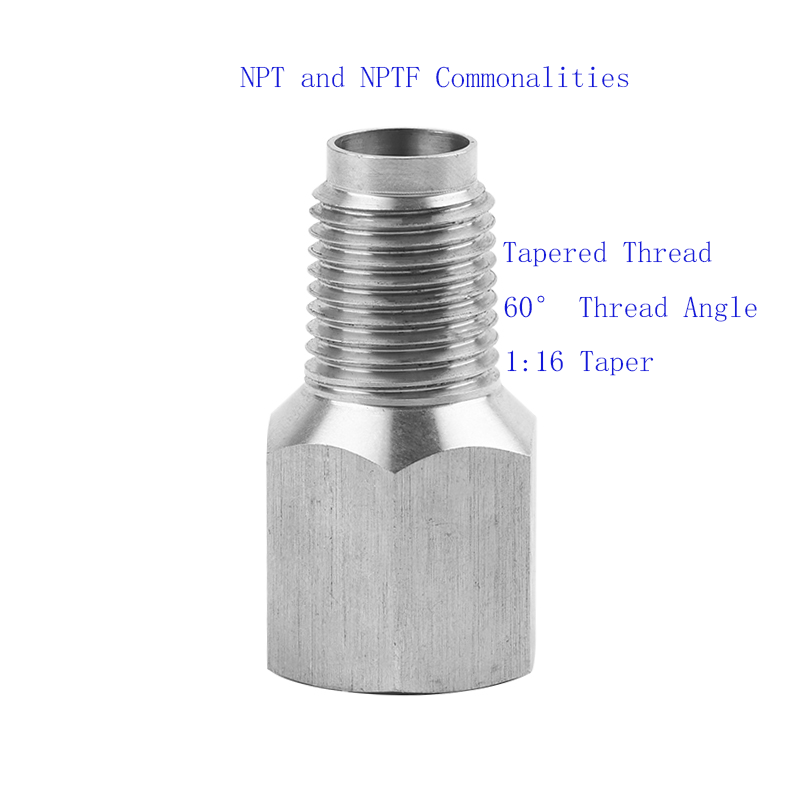
NPT stands for National Pipe Taper. The standard is ASME B1.20.1. The thread is cut at 60°, and it tapers at 1:16 on the diameter — three quarters of an inch per foot, or about 1°47′ on each side.
The taper does the wedging. The seal does not come from the taper alone. NPT threads are cut with a small clearance between the crest of one thread and the root of the other. That clearance leaves a spiral path from the outside of the joint to the inside. Tape or pipe dope fills the path. Without it, an NPT joint weeps.
One number trips people up. The size is nominal pipe size, not the thread diameter. A 1/2 NPT fitting measures 0.840 in across the thread, not 0.500 in. Common thread counts run 27 for 1/8, 18 for 1/4 and 3/8, 14 for 1/2 and 3/4, and 11.5 for 1 in and up to 2 in. That is the thread on most of the NPT fittings in a water or air line.
What NPTF fittings change
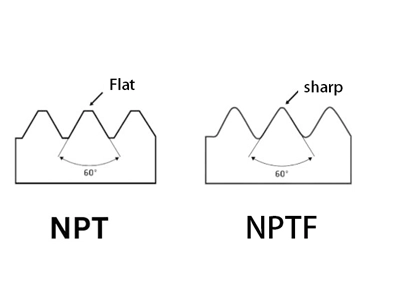
NPTF stands for National Pipe Taper Fuel. The standard is ASME B1.20.3, and the trade name is dryseal. The NPTF fittings you see in a fuel or hydraulic line use the same 60° angle and the same 1:16 taper as NPT. What changes is the height of the thread.
On an NPTF thread the crest and the root are truncated to a controlled height. When the joint tightens, the crest of the male thread presses into the root of the female thread, and the other way round. Metal meets metal along the full length. The spiral path closes mechanically, so the joint seals dry.
There are two classes, and this is where most buyers lose the thread. Class 1 is the default: if the drawing says NPTF and names no class, you are buying Class 1. Class 1 is designed to mate with an NPT female thread, and it still needs sealant. Class 2 is the true dryseal: both sides are NPTF, both are Class 2, and no tape goes on.
Two smaller facts follow. NPTF is right-hand only, while NPT comes in left-hand as well. And an NPTF female thread can be cut straight or tapered, while the male is always tapered.
Where NPTF fittings actually turn up on a quote: fuel and lube lines on engines, propane and natural gas trains, hydraulic pilot circuits, and instrumentation. That last one is on the list for a single reason: a shred of tape can block a half-millimetre orifice. If your line is water at six bar, NPTF adds cost and buys nothing.
NPT fittings vs NPTF fittings, side by side
Two of these rows matter more than the rest when you buy NPT fittings or NPTF fittings: how the joint seals, and which gauge proves it.
| Feature | NPT | NPTF |
|---|---|---|
| Standard | ASME B1.20.1 | ASME B1.20.3 |
| Angle and taper | 60°, 1:16 | 60°, 1:16 — identical |
| Crest and root | Clearance left open | Truncated to a controlled height |
| How it seals | Sealant fills a spiral path | Crest crushes into root |
| Sealant | Required | Not required, if both sides are Class 2 |
| Gauges | L1 plug and ring | L1 plus L2, or a 6-step |
| Taking it apart | Fine, with fresh sealant | Not recommended, the threads deform |
| Usually found on | Water, air, general piping | Fuel, oil, hydraulics, gas |
That last row is the reason NPTF exists. In a fuel or hydraulic line, a shred of tape that works loose can block an orifice or foul a valve. A dry joint removes that risk. It also removes a second risk: sealant that dries out, cracks and lets go under vibration.
The cost difference is not mysterious. An NPTF order carries a full gauge set, a slower finishing pass, and a check that an NPT order skips. NPT fittings are cheaper because they need none of that, not because the steel is different.
Can NPT and NPTF fittings be used together?
The question comes up on every NPT fittings order where the mating port is unknown. Physically, yes. Same angle, same taper, same pitch, so the threads screw together without a fight. That is exactly why so many mismatched joints get made and blamed on bad tape later.
| Male thread | Female thread | What you actually get |
|---|---|---|
| NPT | NPT | The standard joint. Sealant required, and it works |
| NPTF Class 2 | NPTF Class 2 | Dry seal. No tape, no dope |
| NPT | NPTF | Threads go in and it seals with sealant. It is not a dryseal joint. The NPTF side is doing nothing extra |
| NPTF | NPT | Threads go in, sealant required, and the tight tolerances you paid for are wasted |
So the rule is short. If you want a dry seal, both threads have to be NPTF Class 2. If one side is NPT, treat the whole joint as NPT and put sealant on it.
None of this makes NPT interchangeable with BSPT or BSPP. Those are 55° threads. The sizes look close, and a 1/2 NPT male will start into a 1/2 BSPT female, then bind and leak. If the thread family is in doubt, read how NPT differs from BSPT and BSPP before you order.
What changes in the shop when the drawing says NPTF
NPTF fittings are where the print and the shop floor talk past each other most often. This is the part no buying guide covers. A single letter on the print changes four things on the factory floor, and all four show up in the price.
One, the last pass. The crest cannot be left tall. On an NPT thread a slightly high crest is harmless, because the sealant fills the gap. On NPTF the crest is the sealing surface. Cut it too high and the joint will not take sealant and will not seal dry either. The finishing pass has to hit the truncated height, and the tool nose radius has to be right for the pitch.
Two, deburring. A wire brush run over an NPTF thread can round the crest and take the dry seal with it. Satin or light brushing on the flanks is fine. Anything that polishes the crest is not.
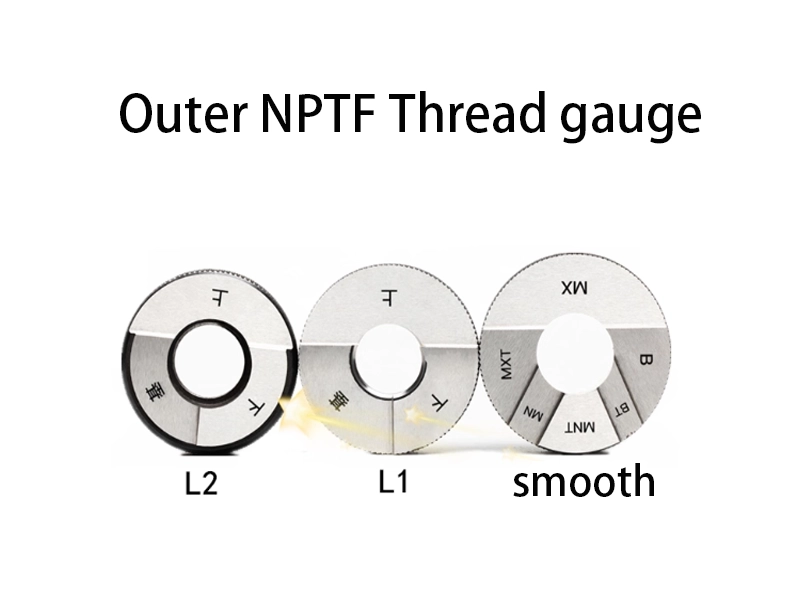
Three, gauges. NPT needs one L1 ring or plug per size. NPTF needs a set. In this shop a set means three gauges: L1 for the pitch diameter, then L2 on external threads or L3 on internal ones for the crest and root. A 6-step gauge does the same job in one pass. Each size needs its own set. We hold them from 1/8 through 2 in, and 2 in is also the largest NPTF size we turn. A shop that quotes NPTF without the second gauge is quoting a thread it cannot prove.
Four, plating. This one bites hardest. A zinc layer runs 2 to 5 microns a side on standard work, and 50 to 80 microns a side on hot-dip galvanizing. The interference NPTF relies on to seal is the same order of size as that coating. So a plated NPTF fitting has to be gauged after plating. Hot-dip is out of the question. The thread has to be re-tapped after the dip, and re-tapping cuts away the controlled crest the seal depends on.
Put together, NPTF carries more inspection and a higher scrap risk. That is why the same drawing quotes differently with one letter changed. We quote both, and the difference is on the sheet instead of in the small print. Our thread checks before packing are described in how we check threads before shipping.
Gauging: L1 proves the size, L2 proves the form
A buyer holding a part in his hand has one practical question: which thread is this? The honest answer is that you cannot see it. The angle, the taper and the pitch are identical, and the crest difference is a few thousandths of an inch. Read the marking on the part or the bag first. If there is none, a 6-step gauge settles it, and a thread comparator does the same job in a lab. Judging the crest with a fingernail works for someone who has cut thousands of them, and it is not a method to put in receiving inspection.
A taper thread cannot be checked like a metric nut. A go/no-go gauge on a straight thread either fits or it does not. A taper gauge always screws in; the question is how far. So the reading is a stand-off, not a yes or no.
Screw the L1 gauge on by hand until it stops. No wrench, ever. On an external thread, the small end of the ring should sit within one turn either side of the part face. On an internal thread, the notch on the plug should sit within one turn of the part face. One turn out and the part is scrap, not rework.
| Check | NPT | NPTF |
|---|---|---|
| Gauge set | L1 plug and ring | L1, plus L2 or L3, or a 6-step |
| What L1 proves | Pitch diameter at the hand-tight plane | The same, and nothing about the crest or root |
| Accept limit | Within ±1 turn of the notch or face | Same, then the truncation checked on its own |
| Wrench on the gauge | Never | Never |
Here is the trap. An L1 gauge passing tells you the pitch diameter is right. It says nothing about whether the crest is truncated. An NPTF part that passes L1 and has a high crest will thread, tighten, and leak dry. That is why the second gauge is not optional on a dryseal order.
A gauge gives a pass or a fail. It does not tell you where the cut went wrong. So when a thread reads out, the part goes under the profile projector. The screen shows the 1:16 taper and the 60° flank angle directly. An angle that is off shows up as an angle that is off, not as a stand-off on a ring. We set the job that way before the first piece ever reaches the gauge, so the operator is cutting to a known taper rather than chasing a number.
What to put on the drawing and the RFQ
Most of the expensive mistakes start in the callout, not in the machine. Six lines fix it.
| Write this | Why it matters |
|---|---|
| 1/2-14 NPT | The standard taper thread. Sealant goes on at assembly |
| 1/2-14 NPTF | This means Class 1. On its own it does not buy you a dry seal |
| 1/2-14 NPTF-2 | Class 2. Both mating parts have to say this, not just yours |
| Gauge standard, and who supplies it | Our NPTF sets run 1/8 to 2 in. Say if the joint must be proved with your own gauge or with a calibration certificate |
| Plating, and whether it must pass after plating | Coating moves the crest. Post-plate gauging is a separate operation |
| Annual quantity and size | NPTF carries more inspection, so volume decides whether the gauge and the setup are worth it |
Three cases where we argue against NPTF. Low-pressure water and shop air do not need it; NPT fittings with tape have held those lines for a century. A joint that comes apart for cleaning should stay NPT, because NPTF threads deform on the first tightening. And anything going through hot-dip galvanizing should stay NPT, for the reason above.
Send the drawing with the thread callout, the material, the plating and the annual quantity. The quote comes back with the thread cost separated from the part cost. We are a machine shop in Taizhou, Zhejiang, not a trading house, and the people who quote the thread are the people who cut it.
Both thread families sit on the same turning line here, alongside the BSPT and BSPP work covered on our custom CNC machining services page. NPTF fittings are a smaller share of what this shop ships, and they get more attention per part because of it. For the stainless side, our stainless NPT fittings range shows the shapes these threads go on.