
Technical Overview: NPT Thread Size Chart and Standards
The American National Standard Taper Pipe Thread (ANSI/ASME B1.20.1) defines the dimensions and geometry of NPT threads. These tapered pipe threads are designed for secure, leak-proof connections in plumbing and industrial applications.
Engineering Geometry & Sealing Mechanism
NPT threads feature a 1° 47′ taper (3/4 inch per foot), with a 60° thread flank angle. This taper creates a crest-to-root interference fit, providing a metal-to-metal seal. To ensure high-pressure integrity, a thread sealant such as PTFE tape or paste is typically used.
| Parameter | Specification |
|---|---|
| Taper angle | 1° 47′ (3/4 inch per foot) |
| Thread angle | 60° |
| Seal type | Mechanical interference with sealant |
Manufacturing Standards & Class Ratings
NPT fittings are manufactured to strict standards, primarily ASME B1.20.1, ensuring consistent thread dimensions and quality. Class ratings, such as Class 150, 3000#, specify the pressure capacity and wall thickness, critical for high-pressure applications.
| Standard | Description |
|---|---|
| ASME B1.20.1 | Defines thread dimensions, tolerances, and testing |
| Class 150 / 3000# | Pressure and strength ratings |
This technical foundation ensures reliable, standardized connections across various industries, providing confidence in the compatibility and performance of Hongqian’s NPT threaded fittings.
Master NPT Thread Size Chart (Nominal to Actual Dimensions)
Our comprehensive NPT thread size chart provides precise dimensional data for all common pipe sizes from 1/8″ to 4″ NPS. This reference table translates nominal pipe sizes into actual measurements, including outer diameters, pitch, and thread counts, ensuring accurate fitting selection and compatibility.
Understanding the difference between nominal and actual dimensions is critical for proper assembly and leak-proof sealing. Our chart includes detailed information such as NPT threads per inch (TPI), hand-tight engagement length (L1), and effective thread length (L2).
For engineers and procurement specialists, having quick access to this data simplifies the process of matching fittings with corresponding pipes, avoiding common issues like mismatched OD or improper sealing.
Downloadable in high-resolution engineering CAD files and PDF specification sheets, this master NPT thread size chart is your go-to resource for precise dimensional reference. It helps ensure your threaded fittings meet industry standards and perform reliably under pressure.
How to Identify and Measure NPT Threads Accurately
Getting the right NPT thread size is critical for a secure, leak-free connection. Here’s our straightforward method to verify NPT threads with precision:
Three-Step Caliper & Pitch Gauge Verification Method
-
- Step 1: Measure the Outside Diameter (O.D.)
Use a caliper to measure the male NPT thread’s O.D. at the crest. For female threads, measure the internal diameter at the threaded section. Remember, the nominal pipe size (NPS) doesn’t always match the actual measured OD. - Step 2: Confirm the Thread Pitch (TPI)
Use an NPT thread pitch gauge to match the threads per inch. NPT threads have specific TPI values depending on the size, which helps distinguish between standard and non-standard threads. - Step 3: Cross-Check Against the NPT Thread Size Chart
Compare your measurements with a reliable NPT thread size chart. Be aware that the nominal size (e.g., 1/2″ NPT) often differs from the actual measured OD. Always verify actual dimensions to ensure compatibility.
- Step 1: Measure the Outside Diameter (O.D.)
Nominal vs. Measured Dimension Pitfalls
-
- Nominal size is just a reference, not the exact dimension.
- Actual OD can vary slightly due to manufacturing tolerances.
- Relying solely on nominal size can lead to mismatched fittings or leaks.
- Always verify with a caliper and pitch gauge for best fit and sealing performance.
Accurate measurement prevents leaks, cross-standard mismatches, and installation issues. Use these steps to ensure your NPT threaded fittings meet exact standards every time.
Standard Disambiguation: NPT vs. Alternative Thread Standards
Understanding the differences between NPT and other thread standards is essential for ensuring compatibility and sealing integrity.
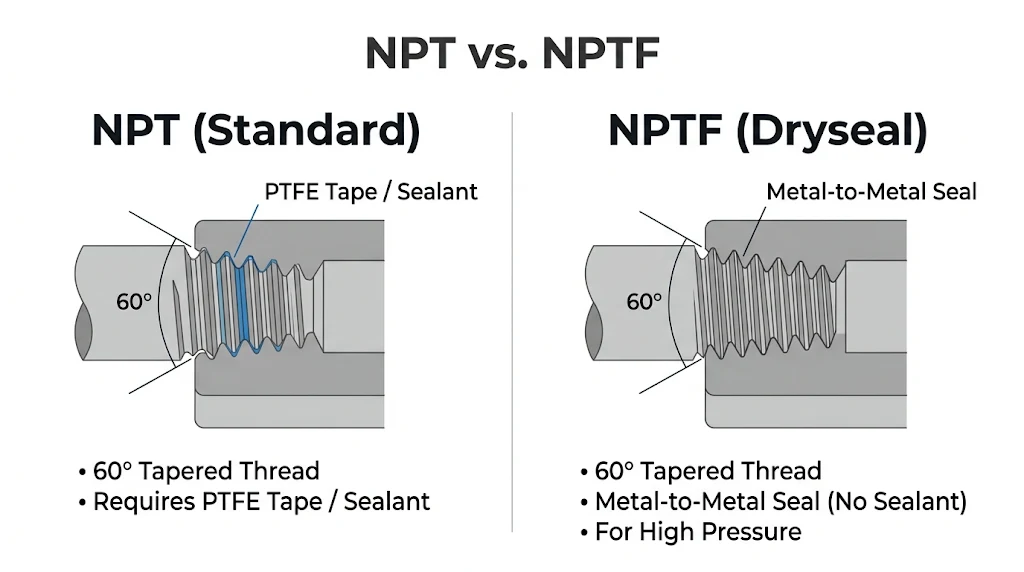
NPT vs. NPTF (Dryseal American National Standard Taper Pipe):
NPTF threads are designed for a dry, leak-proof seal without sealant. They achieve this through a deformation process that creates a metal-to-metal seal, unlike standard NPT threads which typically require PTFE tape or paste. While both share the same 60° thread angle and similar dimensions, NPTF provides a more reliable seal for high-pressure applications.
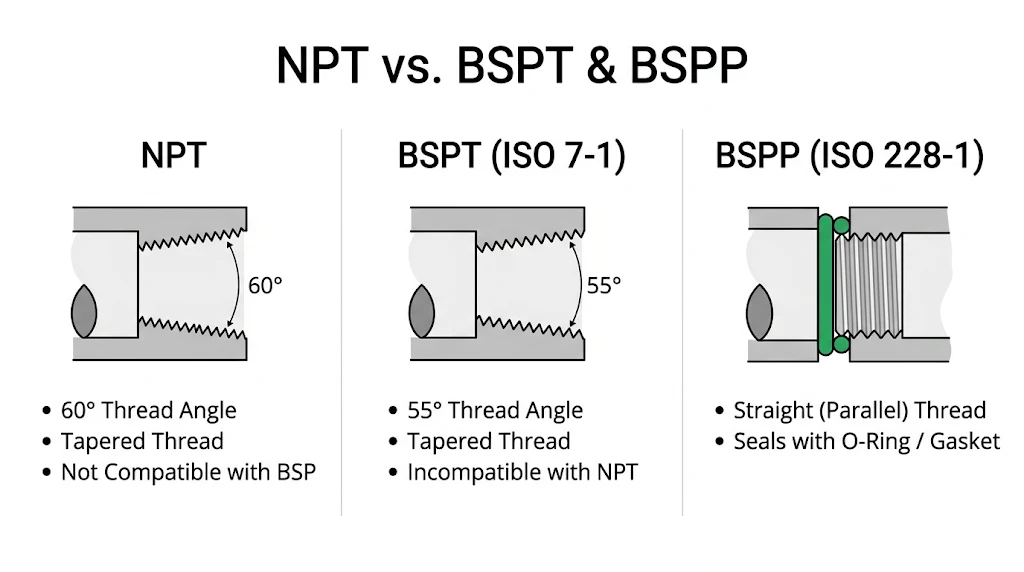
NPT vs. BSPT (ISO 7-1) & BSPP (ISO 228-1):
BSPT (British Standard Pipe Taper) features a 55° thread angle, different from NPT’s 60°, making them incompatible for sealing. BSPT threads are often used in international applications, but they cannot be directly swapped with NPT fittings without risking leaks or damage. BSPP (British Standard Pipe Parallel) has a straight thread design, relying on an O-ring or gasket for sealing, unlike the tapered NPT.
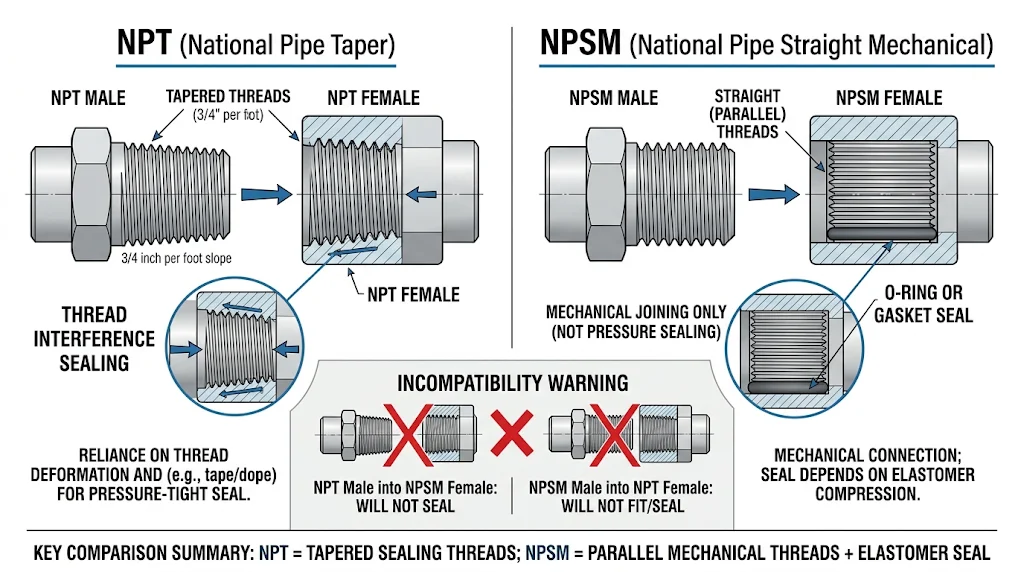
NPT vs. NPSM (Straight Mechanical):
NPSM (National Pipe Straight Mechanical) threads are straight, parallel threads used mainly for mechanical connections, not sealing. They often use an O-ring or gasket for sealing, which makes them incompatible with tapered NPT fittings that rely on thread interference for sealing.
Choosing the right thread standard depends on your specific application, pressure requirements, and compatibility needs. At Hongqian, we supply NPT fittings designed to meet strict standards for reliable, leak-proof connections in the US market.
Quality Control & Dimensional Inspection at Hongqian
At Hongqian, we prioritize strict quality control to ensure our NPT threaded fittings meet the highest standards. Our gaging protocol includes using calibrated plug and ring gauges to verify thread dimensions, ensuring consistency across every batch. We focus on precise measurement of the effective thread length (L2) and hand-tight engagement length (L1) to guarantee proper fit and seal.
Thread crest cleanliness and surface finish are critical for reliable sealing and long-term durability. We maintain a clean, smooth surface finish on all threaded components, reducing the risk of galling and leakage. Our inspection processes ensure that every fitting adheres to ASME B1.20.1 standards, providing confidence in performance and safety for high-pressure applications.
By controlling every step of manufacturing and inspection, Hongqian delivers threaded fittings that are reliable, dimensionally accurate, and ready for demanding industrial environments.
Installation, Torque Limits & Assembly Best Practices
When assembling NPT threaded fittings, following proper installation procedures is critical to ensure leak-free performance and long service life. We recommend the Turns from Finger Tight (TFFT) method, which involves tightening the fitting by hand until it’s snug, then using a torque wrench to tighten to the specified torque value. This approach minimizes over-tightening and prevents damage.
Key points for proper assembly:
– Always start with finger tight engagement, then use a torque wrench for the final turn.
– Refer to the recommended torque limits based on fitting size and material—over-tightening can cause galling or cracking.
– For stainless steel NPT fittings, avoid excessive torque to prevent galling, especially with dissimilar metals.
Anti-Galling & Thread Sealant Rules:
– Use anti-galling compounds or thread sealant designed for tapered pipe threads.
– Apply sealant evenly on the male thread, avoiding excess that could block the sealing surface.
– Sealant helps prevent leaks and reduces the risk of thread damage during assembly.
– Ensure the thread crest remains clean and free of debris before sealing and tightening.
Following these best practices guarantees a secure, pressure-tight connection while protecting the integrity of your Hongqian NPT threaded fittings. Proper torque application and sealant use are essential for safe, reliable operation in any piping system.
Frequently Asked Questions (Technical & Procurement)
What drill bit size is required for tapping a 1/2″ NPT female thread?
For a 1/2″ NPT female thread, the recommended tap drill size is typically 0.469 inches (11.91 mm). Using the correct drill size ensures proper thread formation and prevents issues like cross-threading or incomplete cuts.
Can an NPT male thread seal into a BSPT female port?
While both are tapered threads, NPT and BSPT have different thread angles and pitch. NPT has a 60° thread angle, whereas BSPT uses a 55° angle. They are not directly interchangeable and may not seal reliably without adapters or modifications.
What is the maximum operating pressure of Hongqian 3000# NPT forged fittings?
Our 3000# NPT forged fittings are rated for high-pressure applications, with maximum operating pressures generally up to 3,000 psi. Always verify specific product ratings and installation conditions for your system.
Does Hongqian support custom threading, special angles, or non-standard alloys?
Yes, we offer custom threading options, including special angles and non-standard alloys. Please contact us with your specifications for a tailored solution that meets your project needs.
Request a Technical Quote / Order Hongqian NPT Fittings
We offer custom sizing, material options, and volume RFQ (Request for Quote) capabilities for our NPT threaded fittings. Whether you need specific dimensions, specialty alloys, or large-volume orders, our team is ready to meet your technical requirements.
Custom Sizing & Material Selection
-
- Sizes: From 1/8″ to 4″ NPT, tailored to your project needs.
- Materials: Stainless steel, carbon steel, brass, and other alloys.
- Special Requirements: Non-standard threads, angles, or finishes.
RFQ Process
-
- Provide your specifications for sizing, material, and volume.
- Our engineers will prepare a detailed quote promptly.
- We support rapid prototyping and large-volume manufacturing.
Why Choose Hongqian
-
- Precise manufacturing standards for high-pressure applications.
- Reliable quality control and dimensional accuracy.
- Flexible options for custom threading and material traceability.
Contact Us
Fill out our RFQ form or contact our sales team directly to get a tailored quote for your project. We are committed to delivering high-quality, reliable NPT threaded fittings that meet your exact specifications.