
The price of CNC parts is set by the cut. The cost is often set by something else: how the blank gets into the chuck, and how the finished part leaves the machine. Three systems do that work — a gantry robot, a vibratory bowl feeder, and a robot arm. Each one treats the part differently, and each one only makes sense at volume.
For CNC parts they are usually compared on price, and price is the least interesting difference between them. The difference that decides whether a part arrives acceptable or gets rejected is how many times it is struck between the bar and the box. A bowl-fed part is hit twice before anyone inspects it. A gantry part is placed. An arm-tended part is placed twice.
We run gantry lines and bowl-fed lathes on our own floor, so the trade-offs below are written from the bay rather than from a catalogue. The robot arm is in here because it is the option buyers ask about as soon as a part looks too big for the other two.
Three ways a CNC parts blank reaches the chuck
All three do the same four jobs: separate one part from the pile, orient it, present it to the collet, and take the finished part away. What separates them is how much of that sequence is under control, and what happens at the moment the part stops being held.
A gantry grips the part from start to finish and sets it down. A bowl shakes the part along a track, hands it over, and after the cut lets a spring throw it out of the spindle. An arm grips the part at both ends of the cycle and never lets it fall. Same job, three different amounts of contact, and three different chances of damage.
Gantry robot: one machine, one frame
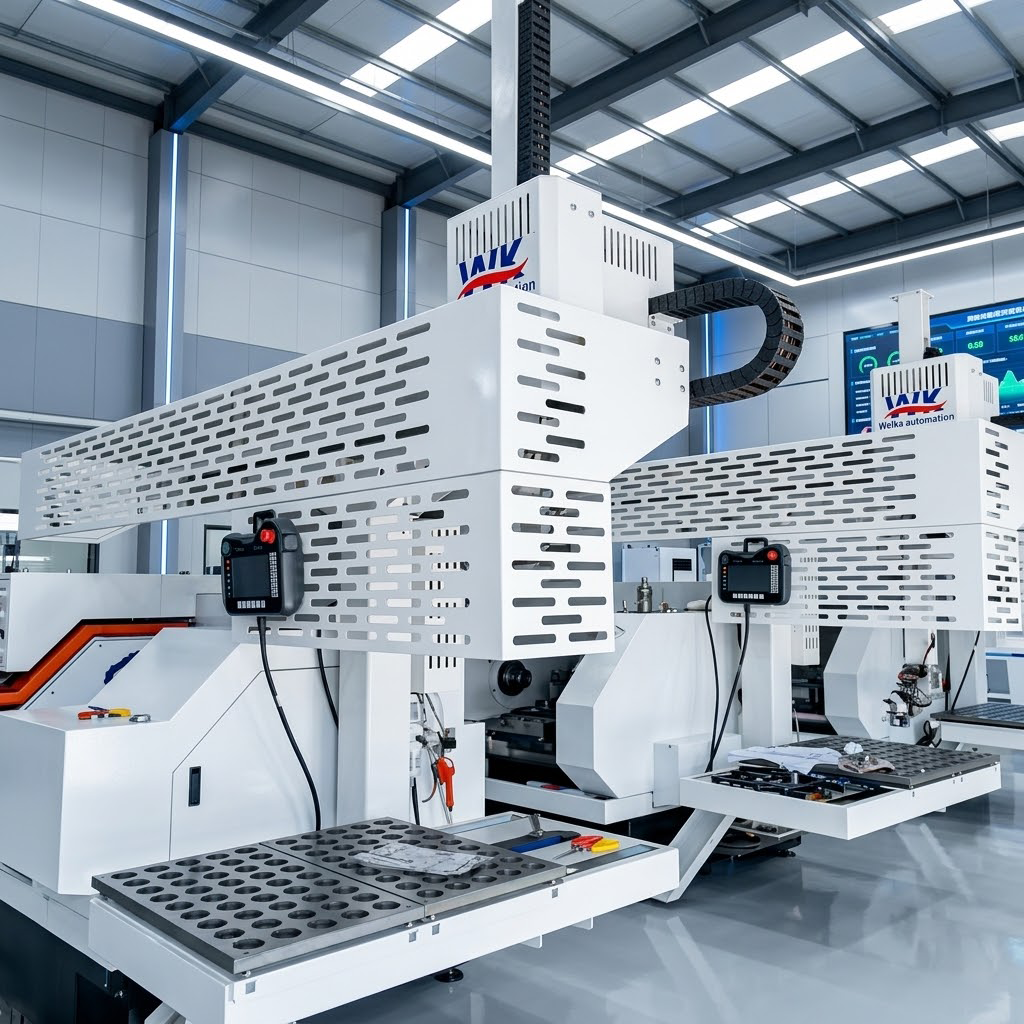
A gantry is a frame built over the lathe with a beam across it and a gripper travelling along the beam. It takes a blank from a tray or magazine, puts it in the collet, and after the cut takes it out again.
What it gains. On small and medium turned parts it is the cleanest of the three, because nothing is ever free in the air. The gripper carries the part out, then either places it in a tray or lets it slide down a rail into the bin — the landing is guided rather than a drop, which is exactly what a visible face or a finished thread needs. Where the part has to arrive unmarked, this is the only one of the three that gives you that as a design feature rather than as luck. It is also the only one that changes product without being rebuilt: within its size range the frame stays where it is, and what changes is the gripper jaws and the program. A bowl’s track is cut for the part it was made for; a gantry just needs another set of jaws.
What it costs. The frame is dedicated: one gantry serves one machine, so twenty lathes mean twenty frames. The hardware runs CNY 20,000 to 50,000, about USD 2,800 to 7,000, against roughly CNY 10,000 for a bowl feeder — two to five times the money for the same one machine served. It also occupies floor area around the lathe that a bowl does not, and none of that cost is shared with the machine next door.
Vibratory bowl: cheapest, and hardest on the part
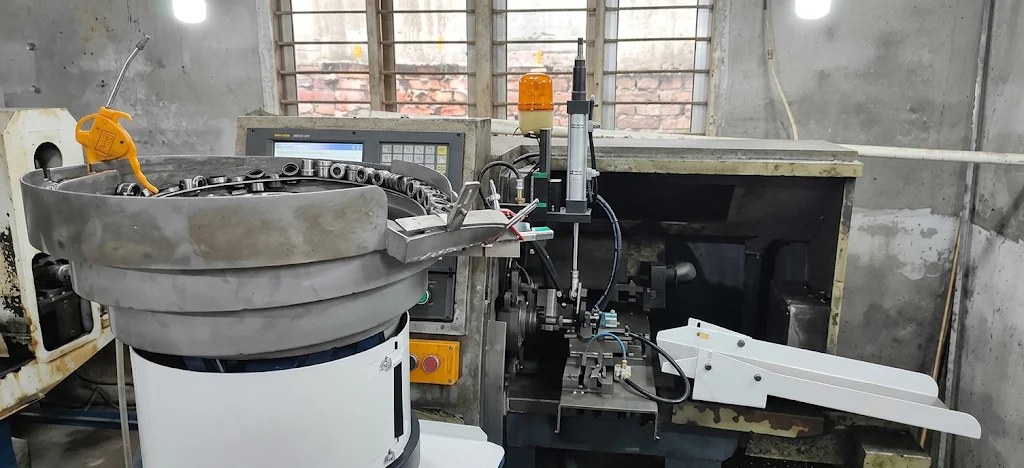
A bowl feeder shakes parts up a helical track that orients them, and a linear track delivers them to the loading station. It is the oldest of the three and still the cheapest way to feed a lathe.
What it gains. The lowest investment of the three by a wide margin — a bowl feeder costs around CNY 10,000, about USD 1,400 — and fast loading. It suits round and hex CNC parts that a bowl can orient on the track — the same band as our hex nuts and threaded fasteners — and the parts it handles run smaller than what a gantry normally picks — a size band where the gantry frame would be overkill for the money.
What it costs. Parts move by being shaken, and they touch each other the whole way up the track: that is the first place a corner or a crest of thread gets marked. Then the cut ends, the collet opens, and a spring pushes the part out of the spindle — it leaves under its own momentum and lands in the bin. That is the second contact, and on a plated or ground part it is the one that shows up in inspection. A bowl is also the loudest thing in the bay; a row of them is a row you shout over.
Robot arm: one arm, two or three machines
A jointed arm on a pedestal, gripper on the wrist, reaching into the machines around it. It is the only one of the three that is not tied to a single lathe — and it is the one a buyer asks about as soon as the drawing gets big.
What it gains. One arm can tend two or three machines, which changes the arithmetic completely: the cell cost is divided by three instead of carried by one. It takes little floor space because it works from a column rather than a frame over the machine. It handles CNC parts large enough that neither of the others can lift them, and it places every part instead of dropping it — so the no-damage property of a gantry, extended to work too heavy for a gantry frame.
What it costs. It only works if the machines it serves sit within reach, and that is a layout decision taken before the cell is built, not after. The arm itself runs CNY 60,000 to 100,000, about USD 8,400 to 14,000, and that is the arm before the gripper, the guarding and the integration. Which is why an arm cell is priced as a project and not as a unit, and why a figure quoted for “the arm” on its own is the start of the number rather than the number.
CNC parts automation compared side by side
Read this by row rather than by column. No single system wins the table; each row is where the choice is actually made. Two rows decide more jobs than the rest: all three need a large batch to pay for the hardware — for most parts hundreds of thousands of pieces — and only the gantry can be turned over to another part number without being rebuilt, which is why a frame already standing takes a run of tens of thousands.
| Gantry robot | Vibratory bowl | Robot arm | |
|---|---|---|---|
| Part size | Small to medium | Small — a step below the gantry | Large |
| Part shape | Anything a gripper can hold | Round or hex only | Anything a gripper can hold |
| Machines served | One | One | Two or three |
| Batch it pays on | Tens of thousands, if the frame is already standing; hundreds of thousands to buy one | Hundreds of thousands | Hundreds of thousands |
| Another part number | Yes, within its size range — new jaws, new program | Track tooling is cut for one part | New gripper, re-taught |
| How the part leaves | Placed in a tray, or slid down a rail | Spring-ejected from the spindle | Placed in a tray |
| Uncontrolled contacts | One, at the bin | Two: on the track, at ejection | None after the gripper closes |
| Floor space | Largest of the three | Small | Small |
| Hardware cost | CNY 20,000–50,000 (USD 2,800–7,000) |
About CNY 10,000 (USD 1,400) |
CNY 60,000–100,000 (USD 8,400–14,000), arm only |
| Noise | Low | Highest | Low |
| Where it wins | Medium parts with a finish or a thread to protect | Small round or hex parts where cost leads | Large parts, or several machines and one operator |
Those figures are Chinese domestic prices for the hardware, converted at about 7.1 to the dollar, and they leave out gripper design, guarding, integration and commissioning — an installed cell costs a multiple of the hardware line. Read them as ratios between the three systems, not as a quote for a cell.
The summary of the table is uncomfortable for anyone pricing CNC parts on the machine alone: the cheapest system is the one that hits the part twice, and the most expensive one buys you a single machine. Divide an arm at CNY 60,000 to 100,000 across three machines and it lands at CNY 20,000 to 33,000 per machine, inside the gantry’s own range — before the gripper and the guarding are counted, which is exactly why an arm is rarely the cheapest per cell and often the cheapest per part.
Which automation goes on your CNC parts quote
Four rules, in the order we apply them.
One: can the part take a hit? If it is a plain round or hex part with no cosmetic face and no thread that will be inspected, the bowl is the answer and the price reflects it. If it cannot be shaken and ejected without marking, the bowl is out before cost is discussed.
Two: how big is it? Small and round or hex goes to a bowl. Small to medium, any shape, goes to a gantry. Large enough that a person would need two hands goes to an arm.
Three: how many machines does the order occupy? One machine over a long run belongs on a gantry. Three machines running the same family belongs on a robot arm, because the cell is paid for once.
Four: how many pieces? All three are volume tools, and this is the rule that rules most jobs out. Buying a cell is a capital decision: for most parts it takes hundreds of thousands of pieces before the hardware pays for itself, and under that, tooling, changeover and idle time eat the saving. A gantry already standing on the floor is the exception — a run of tens of thousands can go on it, because what is new is a set of jaws and a program, not a frame. That is the practical reason the gantry is the flexible one: it can absorb the smaller job that does not justify buying anything.
What to tell us before we pick a loader
| On the drawing or the RFQ | Why it changes the answer |
|---|---|
| Diameter, length, weight | It decides whether a bowl can carry the part at all, and whether a gantry frame is sized for it or overbuilt. |
| Shape, and whether it is round or hex | A bowl can only orient what its track was built for. A profiled body rules the bowl out. |
| Which surface is cosmetic | It decides whether the part may touch anything at all, which is the difference between a bowl and a gantry. |
| Thread, and whether it is cut before or after plating | A thread is the first feature a bowl marks, and a plated thread shows a mark that a bare one hides. |
| Volume per order and per year | Cell cost is divided by pieces. The same part at 2,000 and at 50,000 does not want the same cell. |
| Whether the part may be dropped | If yes, the cheap answer is on the table. If no, it is not a price question any more. |
What this means for a CNC parts order
Nothing here is new engineering. It is the reason two quotes for the same CNC parts drawing can differ by a wide margin without either shop being dishonest: one quoted a bowl-fed part and the other quoted a gantry-fed part, and both were right for the cell they had in mind. The number that matters is the one on the part, not on the machine.
Our own lines are gantry-fed and bowl-fed, more than sixty CNC automatic lathes between them, and the choice on a given drawing is made before the quote goes out rather than after the first batch is rejected. Where a part outgrows both, an arm cell is a project with a layout attached rather than a line in a catalogue. What the workshop runs end to end is on the machining services page.
If you are choosing between suppliers, the question worth asking is not which automation they own — it is which one they will put your part on, and whether the answer changes once they see the drawing. A shop that answers that before quoting is a shop that has already thought about the mark on your part.
Frequently asked questions
01Can one gantry robot feed more than one lathe?
A: No. A gantry is a frame built over a specific machine, so one frame serves one lathe — twenty machines mean twenty frames. That is the single biggest reason it costs CNY 20,000 to 50,000 against about CNY 10,000 for a bowl feeder: you are not buying a loading system, you are buying one per machine.
02Why do bowl-fed CNC parts arrive marked more often?
A: Because a bowl gives the part two uncontrolled contacts, not one. Parts travel up the track by vibration and touch each other on the way, which is where a corner or a crest of thread is first marked. Then the collet opens and a spring pushes the finished part out of the spindle under its own momentum — that second contact is the one that shows on a plated or ground surface.
03Is a vibratory bowl always the cheaper choice?
A: Cheaper to buy, not always cheaper per part. At around CNY 10,000 it is the lowest investment of the three and the fastest to load, but it only orients what its track was built for, it handles a smaller size band, and the two impacts limit it to parts where a mark does not matter. On a part with a cosmetic face, the scrap it creates can cost more than the difference to a gantry.
04When does a robot arm beat a gantry on cost?
A: When it has two or three machines to serve. An arm at CNY 60,000 to 100,000 divided across three machines lands at CNY 20,000 to 33,000 per machine, which is inside the gantry's own range of CNY 20,000 to 50,000 — and that is before the gripper and guarding are added. On a single machine the arm is the wrong answer; on three machines running the same family it usually is not.
05What part shapes rule a bowl feeder out?
A: Anything its track was not built to orient. Round and hex parts orient reliably; a profiled body, a part that nests with its neighbour, or one that will not sit in a known attitude will jam the track or arrive wrong way round. If the shape has no single stable orientation, the bowl is not a price question, it is a no.
06How many pieces before automation pays for itself?
A: Buying a cell is a capital decision, so the answer follows the process rather than a single figure — but for most parts it takes hundreds of thousands of pieces before the hardware pays back, and under that the tooling, the changeover and the idle time eat the saving. A gantry already standing on the floor is the exception: a run of tens of thousands can go on it, because the only new items are a set of jaws and a program.
07Can you run a part that must not carry a single mark?
A: Yes, on a gantry — it grips the part through the cycle and places it down or guides it down a rail instead of dropping it. What we need from the drawing is which face is cosmetic, because that decides the gripper and the landing, and it also tells us whether the part may go anywhere near a bowl.
08Q8. Can a small batch still run on a gantry?
A: Yes, if the frame is already standing. The frame is independent of the part; within its size range, changeover is a set of jaws and a program, which is why a run in the tens of thousands can be loaded on a frame that has already paid for itself. That is a different question from justifying a new frame, which usually takes hundreds of thousands of pieces.