
The 304 stainless steel parts in this story were finished, packed and waiting for the courier when the buyer’s message arrived: the parts we had quoted as non-magnetic were attracting a magnet, and could we demagnetize them before shipment. The buyer was right about the observation and wrong about the fix, and the gap between those two things is what this article is about.
This is a real order from a Russian buyer, machined in our own workshop in Yuhuan, Taizhou, Zhejiang. The parts were turned from ground bar stock, and the sequence that followed — a failed demagnetizer pass, then a tempering route that worked at the cost of a slight change in surface appearance — is a decision path most buyers never see. We are publishing it because the same complaint reaches almost every manufacturer of 304 stainless steel parts at some point, and because the fix is not the one people expect.
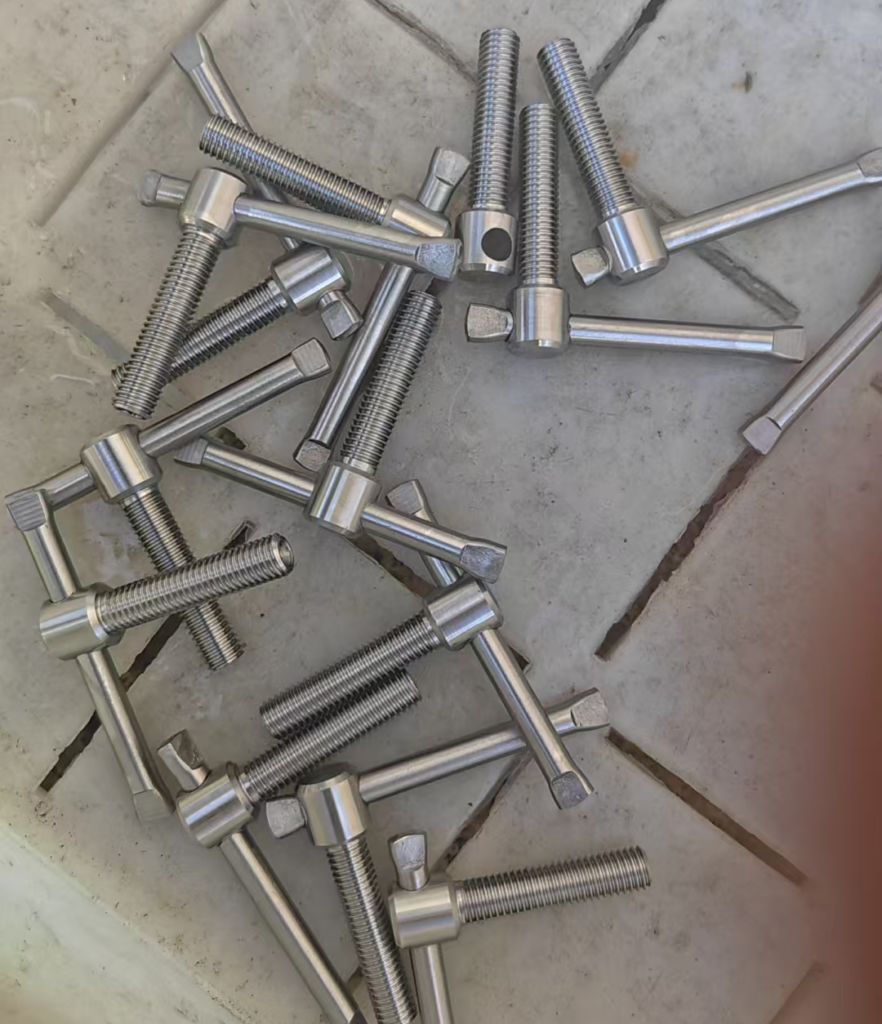
The 304 stainless steel parts that came back marked “magnetic”
304 is the grade most buyers reach for when they want “stainless” in the everyday sense: corrosion resistant, weldable by the right shop, and — in the annealed state — non-magnetic. That last property has become a shorthand in purchasing. A magnet sticks, the part is suspect; a magnet does not stick, the part is genuine. It is a cheap test and it travels well across languages, which is why a buyer in Russia and a factory in Zhejiang could disagree about a shipment using nothing more than a fridge magnet.
Our parts failed that test. The buyer’s quality people put a magnet to the machined bodies and it held. To them that read as one of two failures: either we had shipped a cheaper magnetic grade instead of 304, or the parts had picked up stray magnetism that we should remove. The first accusation we could disprove with the mill certificate — the heat number on the bar matched EN 10204 3.1 documents we had already sent. The second was the real problem, and it had a cause worth explaining before any fix was attempted.
Why ground bar and CNC turning make 304 stainless steel parts magnetic
Two facts were in play, and both had been true from the day the order was placed.
| Source | What happens | Where it showed up in this case |
|---|---|---|
| Ground bar stock | Cold drawing and grinding are heavy plastic deformation. In 304 that deformation converts some of the paramagnetic austenite into ferromagnetic strain-induced martensite. | The magnetism was present before any machining, on the raw bar itself. Every cut-off stick passed a magnet test. |
| CNC turning and thread cutting | Machining adds more local deformation at the surface and in the thread roots, so the machined faces read more magnetic than the bar. | The buyer tested the machined OD and threads — exactly the zones with the most induced martensite. |
The mechanism is well documented: 304 is a metastable austenitic steel, and plastic deformation drives part of the austenite into α′ martensite, which is ferromagnetic. Studies that measure magnetic permeability during the deformation of 304 use exactly this transformation as their signal. Peer-reviewed work has tracked the austenite-to-martensite conversion under plastic strain and the resulting jump in magnetization, and the surface-deformation route to the same transformation has been imaged directly at the atomic scale [1][2].
Two consequences follow for anyone buying machined 304 parts. First, magnetism is not evidence of a substituted grade: a genuine 304 bar that has been ground, drawn or machined will attract a magnet. Second, the magnetism lives in the microstructure, not in a field the part picked up. That second point decided everything that happened next, though we did not fully appreciate it until the first fix failed.
Attempt one: the demagnetizer
A demagnetizer was the obvious first move, and we had reason to be confident: we run carbon steel fittings through a demagnetizing step as part of normal production, so the equipment and the habit already existed in our workshop. The parts went through the same cycle that clears residual magnetism on carbon steel hardware. The result: the parts still held the magnet, essentially unchanged.
Looking back, the failure was predictable. A demagnetizer works by exposing the part to a reversing, decaying magnetic field. That clears residual magnetism — a permanent magnet’s history stored in a ferromagnetic part. It does not touch the microstructure. Our 304 was not magnetized in that sense at all; a fraction of its surface had turned into martensite, and martensite is ferromagnetic the way a permanent magnet’s steel is ferromagnetic. You cannot “demagnetize” a phase of the metal out of existence with a coil. Industry explanations of the same phenomenon make the same distinction: physical demagnetizing is temporary or ineffective where the magnetism comes from the structure, and only changing the structure removes it [3][4].
This is also the point at which the ordering of operations matters. If the buyer had asked us to demagnetize the bar stock before machining, the result would have been the same failure, and the machining would have re-induced magnetism anyway. Demagnetizing 304 stainless steel parts only makes sense as the last step after the final cut, and only if the chosen process can actually alter the microstructure.
Attempt two: tempering
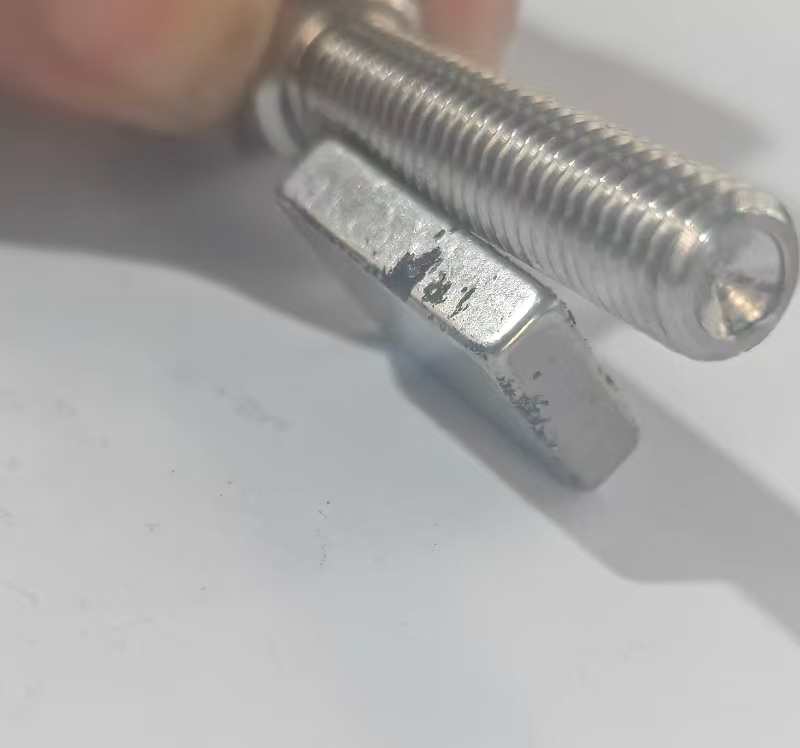
The second route attacked the structure instead of the field. We ran the finished parts through a stress-relief temper — a controlled heat treatment, not a solution anneal. Heating gives the strained structure enough energy to recover: part of the deformation-induced martensite reverts or loses the ferromagnetic character that made the parts attract the magnet. After tempering, the magnet test we and the buyer had been using came up clean.
The trade-off showed up on the surface. Tempering left a fine change in gloss — most likely a very thin oxide film from the heat, the kind of shift you notice when two parts from different process stages sit side by side. The dimensions did not move; the threads still gauged. We photographed the tempered parts, sent the pictures, and put the choice to the buyer plainly: this is the appearance we can achieve, and this is the magnetism result that comes with it. The buyer compared the photos against the requirement that actually mattered to their market and accepted the change. The shipment went out.
| Route | What it acts on | Result on our parts | Surface |
|---|---|---|---|
| Demagnetizer | Residual magnetic field only; the microstructure is untouched | Magnetism remained — failed | No change |
| Stress-relief temper | The deformation-induced martensite itself | Magnetism receded to the level the buyer accepted — worked | Fine change in gloss; dimensions and threads unchanged |
| Solution annealing (not used) | Full reset of the structure at ~1,050 °C | Would also work, but re-softens and risks distortion on finished parts | Scale and possible distortion — wrong tool for finished parts |
What the surface looked like and what the buyer accepted
It is worth being precise about what “accepted” meant, because this is the part of the case a buyer can reuse. The magnet test had never been on the drawing. It was a screen the buyer applied because magnetic 304 stainless steel parts look wrong to their customers. Once we showed that (a) the grade was certified, (b) the magnetism came from grinding and machining, which are unavoidable for a turned part, and (c) the temper removed the magnetism but moved the gloss slightly, the buyer had a real decision to make instead of a rejection to process. They chose the tempered surface. The alternative — insisting on the original gloss — would have meant accepting the magnetism, because on deformed 304 the two travel together.
If magnetic response is a real requirement on your own project, it belongs on the drawing, with a number: a field strength limit or a ferrite count, measured with a gaussmeter or a ferritescope, on specified surfaces. “Non-magnetic” as a bare word on a print for machined 304 is not enforceable, because the honest answer depends on how much cold work the part has seen — and a turned part has seen a lot.
A checklist for magnetic-sensitive stainless steel parts
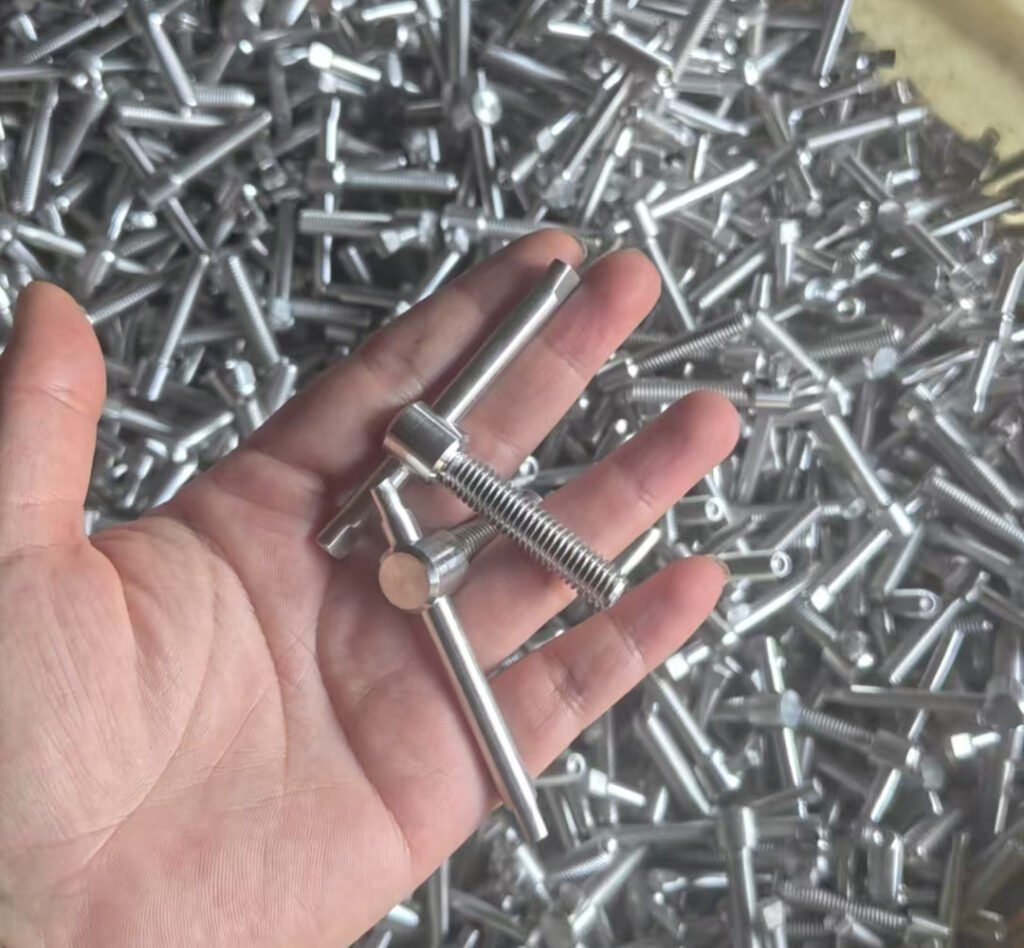
The same conversation comes up with buyers in different markets, so we now raise it before it becomes a complaint. Five lines cover almost every case:
| Check | What to settle before the order |
|---|---|
| Is the magnet test real? | If magnetism is functionally important (sensor housings, instrument parts), put a numeric limit and a measuring method on the print. If it is cosmetic reassurance, say so — the fix differs. |
| What is the raw material route? | Ground and drawn bar arrives with deformation-induced magnetism already in it. If the surface must test non-magnetic as-received, the callout has to say so, and the cost changes. |
| Which surface is being tested? | Machined faces, thread roots and cut edges carry more induced martensite than the bulk. A part can pass on one face and attract a magnet on another. |
| Is appearance negotiable? | Tempering works but shifts gloss slightly. Agree on acceptable appearance in advance; a photo exchange is cheaper than a rejected shipment. |
| Who measures, and when? | Agree that the check happens after final machining, on named faces, with the method named. Testing bar stock proves nothing about the finished part. |
We machine 304 and 316 turned parts to print in our own workshop — the threaded families are on the 304 stainless steel pipe fittings page, and the full turned range sits in the stainless steel pipe fittings category. If your application cares about magnetic response, send the drawing with the requirement written as a number rather than a word; cases like this one are easier to price before the parts are cut than after. Where the parts need more than turning, the same factory handles it through our machining services beyond standard fittings.
Frequently asked questions
01Q1. Why do 304 stainless steel parts attract a magnet after machining?
Machining, grinding and cold drawing are plastic deformation, and in 304 that deformation converts part of the paramagnetic austenite into ferromagnetic strain-induced martensite. The effect is strongest exactly where the buyer tested: machined faces, thread roots and cut edges. It is the material responding correctly to cold work, not a substituted grade.
02Q2. Can a magnet test prove that a stainless steel part is genuine 304?
No. A magnet test is a screening method, not a grade proof. Annealed 304 does not attract a magnet, but any genuinely 304 part that has been ground, drawn or machined can read magnetic. The reliable document is the mill certificate with a heat number, not the fridge magnet.
03Q3 Does a demagnetizer remove magnetism from machined 304 parts?
Not in this situation. A demagnetizer clears residual magnetic fields; it does not change the microstructure. When the magnetism comes from deformation-induced martensite inside the metal, the parts stay magnetic after the cycle — which is exactly what we measured on the order described in this article.
04Q4. What actually worked when you had to demagnetize 304 parts?
A stress-relief temper. Heating lets the strained structure recover, and the deformation-induced martensite loses the ferromagnetic character it gained during machining. On our order the magnet test came up clean after tempering. The trade-off was a fine change in surface gloss, which the buyer reviewed from photos and accepted.
05Q5. Does tempering change the dimensions or the threads of the parts?
On our parts the dimensions did not move and the threads still gauged after tempering. What changed was the surface appearance — a slight shift in gloss, most likely a very thin oxide film. That is why the appearance should be agreed on with photos before the batch ships, not negotiated after a rejection.
06Q6. Is solution annealing a better way to demagnetize 304 parts?
It works on the structure too, but it is the wrong tool for finished parts: solution annealing resets the whole microstructure at around 1,050 °C, which re-softens the material and risks distortion and scale on machined surfaces. For finished turned parts, a stress-relief temper achieved the magnetic result without those risks.
07Q7. How should I specify magnetism on a drawing for 304 stainless steel parts?
As a number, not a word. Put a field-strength limit or a ferrite count on the print, name the measuring method (gaussmeter or ferritescope) and the surfaces to test, and state that the check happens after final machining. "Non-magnetic" written as a bare word is not enforceable on a machined 304 part.