
Cost on CNC turned components is decided in four places: how much material is bought and how much of it leaves the machine as chips, how long the part sits in the spindle, how many purchase orders the shop has to place around it, and how much of the work a person still does by hand. Three of those four can be moved. None of them moves for a small order.
Most cost advice on CNC turned components starts with the drawing: simplify the geometry, loosen the tolerances, avoid deep pockets. That advice is correct and, in production, mostly unavailable — by the time a part is running, the drawing is frozen by the customer’s own approval cycle. What is still open is the blank, the purchase order and the cell. Those are the three levers below, in the order they pay.
Where the cost of CNC turned components actually sits
A turned part carries five lines: material, machine time, setup and tooling, finishing, and the commercial wrapper of packaging, freight and the supplier’s margin. In a bar-fed job the material line is usually the one with the most money in it and the least attention paid to it, because it is set on the day the bar diameter is chosen and then inherited by every quote after that.
Machine time is the line buyers argue about and the one a machine shop controls least, since cycle time follows the material and the geometry. Setup and tooling are a fixed sum divided by quantity, which is why the same part has three different prices at three different volumes. Finishing is bought by the barrel. The commercial wrapper is bought by the container. None of those four behaves the same way at 2,000 pieces as at 200,000.
The gate: without volume there is nothing to reduce
This is the part that cost guides on CNC turned components leave out, and it is the first thing a supplier checks. Not every part can be made cheaper. A part that runs twice a year at 300 pieces is already at its floor, and the floor is set by things nobody in the chain can negotiate.
The blank is the clearest example. Bar comes in standard diameters, and the diameter you actually want is often stocked only in mill quantities; a stockist will cut you two metres of it, at a premium that goes straight into the piece price. Below a certain quantity the order cannot even reach the blank maker’s minimum, so the blank is bought at the worst price in the chain and every later saving is measured from that number.
Setup behaves the same way and the arithmetic is easy to check. Two hours of programming, fixtures and first-article approval is 7,200 seconds; spread over 200 pieces that is 36 seconds added to every part, over 20,000 pieces it is 0.36 seconds. At a cycle time of 40 seconds, one of those orders is nearly twice the price of the other before a single chip is cut.
Lever one: change the blank, not the drawing
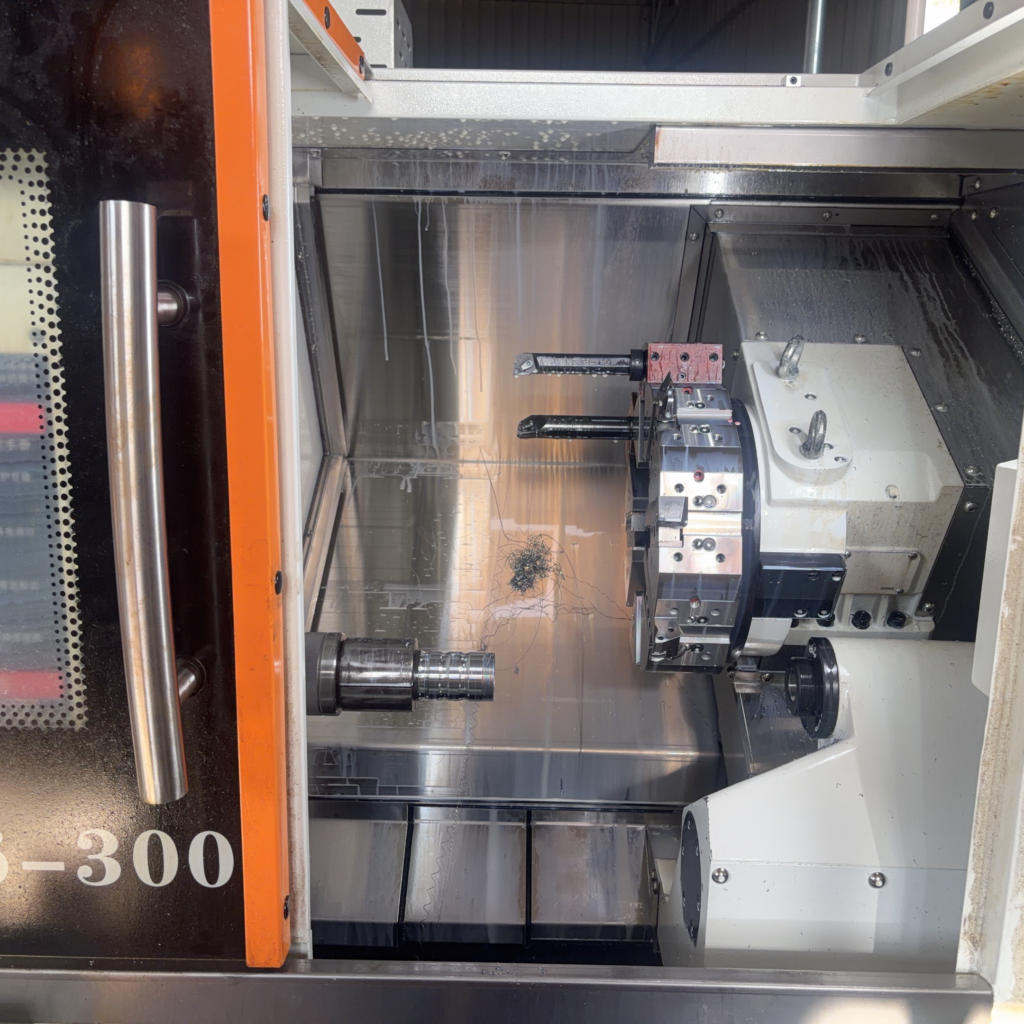
A bar-fed part starts as a cylinder and is cut down to the shape on the drawing. Everything between the bar surface and the finished surface is bought at bar price and sold at scrap price. The most direct cost reduction on CNC turned components is therefore not a machining change at all — it is to stop buying that material in the first place, by forming a blank close to the finished shape and machining only what has to be accurate.
Two processes do that here. Hot heading — what we call hong chong on the floor — heats the billet and forms a near-net body, head or flange, leaving 1–2 mm of allowance on the surfaces that will be machined. Cold heading does the same at room temperature, with better dimensional control and work-hardened material, and with far more expensive tooling. Both are old processes; what has changed is how often they are worth the tooling on parts that have always been bought as bar.
Take a 30 mm body with a hex across flats, a through bore and a thread at each end — a shape that covers a large share of the CNC turned components we quote. It can be made three ways, and the difference is in what is bought and what is cut away.
| Bar, turned | Hot-headed blank | Cold-headed blank | |
|---|---|---|---|
| Starting stock | Next standard bar above 30 mm, often 34 or 42 mm | Formed body, 1–2 mm allowance | Formed body, 0.3–0.8 mm allowance |
| Material into chips | 22% from 34 mm, 49% from 42 mm | About 6–12% | About 2–5% |
| Tooling | Jaws only | One die set, lower cost than cold | One die set, the most expensive of the three |
| Minimum order | 1,000 pieces | 3,000 pieces | 50,000 pieces |
| Size band | Anything up to 300 × 300 mm | Larger sections, hot metal flows further | Practical up to about M24 in steel |
| Where it fits | Long slender parts, tight concentricity, mixed sizes | Headed or flanged bodies in the mid hundreds of thousands or less | Small hex and round parts at high volume |
The chip figures are geometry, not opinion: for a plain cylinder the share removed is 1 − (finished diameter ÷ starting diameter)², ignoring facing and parting loss. A 30 mm part from 42 mm bar loses 49% of the bought steel; the same part from a headed blank loses a tenth of that. Chips come back at scrap price, which is a fraction of what the bar cost, so the gap is real money on every piece.
Three things decide whether the blank change is available. The shape has to carry a head, a flange or a thick-to-thin section, because heading moves metal rather than removing it. The tolerance has to sit on surfaces that can still be machined after forming — heading gives you a blank, not a finished part. And the quantity has to clear the tooling: a die set is a one-off cost, and it is only repaid by pieces. Tooling is free to replace for the life of the part number if it wears or breaks in production, and above roughly 10,000 pieces it is often waived outright, depending on part size.
Lead time moves with the lever. A bar-fed first article is one to two weeks. A headed part needs the die first — 15 to 20 days — then a sample off the tool, another 7 to 10 days, so about four weeks to a sample in your hand.
Lever two: purchasing power, the lever buyers forget
This one is the most overlooked and the least technical. A factory has to keep a margin; it is not a charity and it will not run your part at a loss to win a reference. What it can do is buy better, and what it can buy better depends entirely on how much it is buying at once.
Behind every order of CNC turned components sit four purchases: steel, surface treatment, packaging and freight. At volume all four are negotiable. Steel is priced by the tonne, so a 20-tonne call gets a mill or stockist price that a 2-tonne call does not. Plating is priced by the barrel load, and a small lot pays a minimum charge for a barrel that is half empty. Printed cartons have their own minimum, so a small order ships in a stock box at a higher unit cost. Freight is the same story one level up: consolidated into a container it is a fraction of what it costs as loose cargo.
When the quantity is small, all four of those can add something like 10% between them, and no amount of negotiating removes it. A buyer asking for the large-volume price on a small-volume order is not negotiating; he is asking us to book a loss, and a manufacturer that agrees is either buying worse material or planning to make it up on the next order. Both outcomes arrive later, on the certificate or on the parts.
How to buy CNC turned components at volume without buying more parts
Most buyers cannot double their forecast, and they do not have to. Volume in purchasing terms is what one purchase order covers, not what one part number needs. Four ways to create it:
One blanket order, released monthly. The mill and the plater price the commitment, not the release. Twelve releases against one annual commitment buy at the annual price.
Group part numbers by material. Six parts in 304 bought as one steel call is one negotiation instead of six, and the mill ships one heat.
Group them by finish. A barrel of zinc plating runs on one thickness and one passivation; parts that share both can share the barrel.
Keep one grade across a family. Every extra grade is an extra mill line, an extra certificate and an extra minimum. Substituting 303 for 304 to make one part cheaper often makes the family more expensive.
Lever three: automation, and why it comes last
On CNC turned components, automation attacks the labour line and nothing else. It does not make steel cheaper, it does not shorten a plating barrel, and it does not fix a blank that was too heavy to begin with. On a part where material is half the price, a gantry that removes the operator from the cell is worth less than a blank that removes half the chips.
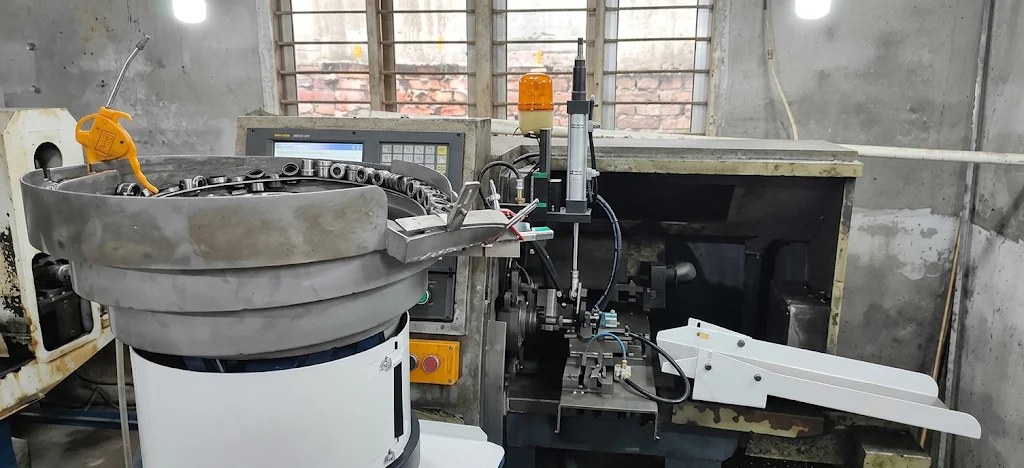
It is also the lever with the highest entry price. A gantry frame is around CNY 20,000 to 50,000 and serves one machine; a bowl feeder is about CNY 10,000 and serves one machine but only handles small round or hex parts; an arm is CNY 60,000 to 100,000 and can serve two or three machines. All three pay back on volume — for most parts in the hundreds of thousands of pieces — and only the gantry carries over to the next part number, which is why a frame already standing in the workshop can take a run of tens of thousands. What the cells on our floor handle end to end is on the machining services page.
What to send so the numbers can move
A cost review on CNC turned components needs more than a drawing. The six items below decide which of the three levers is even available.
| In the RFQ | What it unlocks |
|---|---|
| Drawing and 3D model | Which features force a bar, and which could be formed close to size. |
| Annual quantity, and batch size | Whether a die is repaid, and whether the purchasing lines get a commitment to price. |
| Material grade as written on the drawing | Whether a free-cutting grade is allowed, and whether the family can share one heat. |
| Which surfaces are functional | How much allowance can stay as-formed instead of being machined away. |
| Finish specification and salt-spray hours | Which barrel the parts can share, and whether the thread has to be re-tapped after plating. |
| Target cost, and the year it applies to | Whether the target is a negotiation or a redesign, which are two different projects. |
Three answers that are not cost reduction
Because the honest levers need volume, low-volume buyers get offered other things. Three of them look like savings and are not.
A matched price from a trader. If the number is well below the material cost of the part, the material changed. It shows up in the certificate, but only if you ask for one to EN 10204 3.1 and read the heat number against the drawing.
A tolerance quietly widened. Cheap until the part reaches assembly, and then it is a conversation between your fitter and your engineer, with the supplier out of the room.
A finish skipped after plating. Hot-dip galvanised threads have to be re-tapped, or the nut will not go on. A supplier who skips it saves a step and costs you a batch, and it is the kind of saving that only surfaces when someone tries to assemble.
What we will and will not promise
On a part with the right shape and the volume to carry a die, we will quote CNC turned components two ways — headed blank against bar-fed — and show you the difference, because that is the lever with the most money in it. On a low-volume part we will tell you the price is already at its floor rather than invent a discount and take it back somewhere else. Our own turning, heading and cold forming are in one workshop in Taizhou, Zhejiang, which is why the comparison can be made before the quote rather than after the first batch — the same floor that makes our hex nuts and threaded fasteners and the turned parts we run in stainless.
Frequently asked questions
01Q1. Why is a small order not cheaper per piece?
A: Because the price floor is set before machining starts. The bar diameter you need is often stocked only in mill quantities, so a small order buys its blank at the worst price in the chain; two hours of programming and first-article approval spread over 200 pieces adds 36 seconds to every part. Neither of those is negotiable — they are arithmetic.
02Q2. Which CNC turned components can move from bar stock to a headed blank?
A: Ones with a head, a flange, or a thick-to-thin section — heading moves metal rather than removing it, so the shape has to have somewhere for the material to flow. Parts that stay on the bar are long slender shafts, parts where concentricity runs the whole length, and profiles with undercuts that a die cannot release.
03Q3. Hot heading or cold heading — how do we choose?
A: By size, quantity and how much accuracy you need before machining. Hot heading takes larger sections, uses cheaper tooling, and leaves 1–2 mm of allowance because the part cools and scales. Cold heading holds 0.3–0.8 mm, work-hardens the material, and is practical up to about M24 in steel — but the die costs more, so it needs the larger quantity.
04Q4. Does forming the blank change the material properties?
A: It changes them, and in which direction depends on the process. Cold heading work-hardens the steel, so the blank is stronger and less ductile before machining; if the drawing calls for a property class, that has to be checked after any heat treatment rather than assumed. Hot heading leaves a normalised structure and a decarburised skin that the machining allowance removes. Both are covered on the material certificate to EN 10204 3.1.
05Q5. What quantity unlocks each route?
A: Bar-fed turning starts at 1,000 pieces, hot heading at 3,000, cold heading at 50,000. Those are the points where the blank maker's minimum and the die cost are both carried. Tooling is a one-off and is replaced free for the life of the part number if it wears or breaks in production; above roughly 10,000 pieces it is often waived, depending on part size.
06Q6. How long does a headed part take to sample?
A: About four weeks. The die takes 15 to 20 days, then a sample off the tool takes another 7 to 10 days. A bar-fed first article is one to two weeks, which is why a headed part is only worth quoting when the volume is already there.
07Q7. How do I know the material was not substituted?
A: Ask for a certificate to EN 10204 3.1 and read the heat number and the chemistry against the drawing, not just the file name. A price well below the material cost of the part is the warning sign; the certificate is what turns it into evidence.