
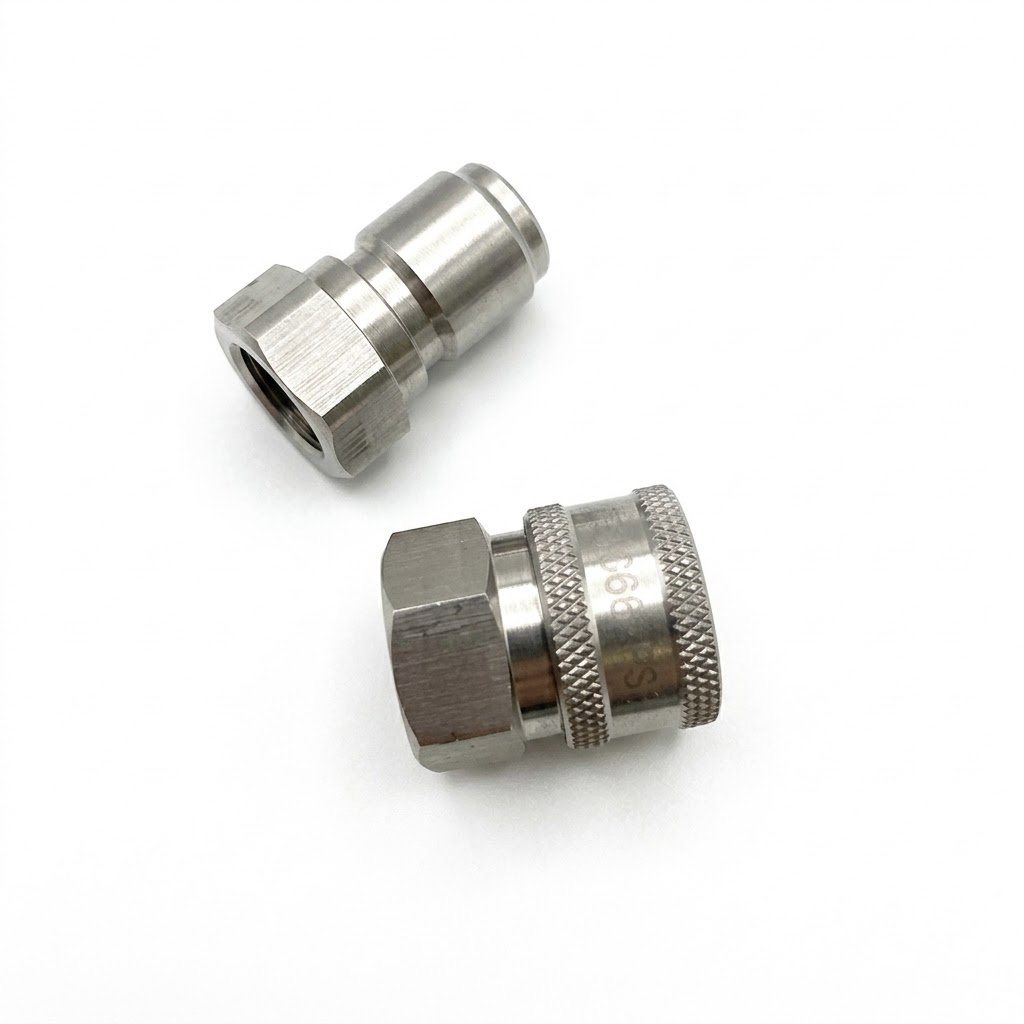
Custom stainless steel quick connect fittings are machined in our Taizhou workshop against a drawing, not picked off a shelf. There is no coupler catalogue here: what leaves the shop is a body — barrel, ball holes, O-ring groove, sleeve — cut to your print and assembled with the parts it names.
Most of it is a pneumatic quick coupling: the air-line coupler a buyer cannot find as a standard item, because the thread, the hose end or the body shape is in nobody’s range. Those orders are the whole book on this page.
Custom stainless steel quick connect fittings: the range we quote
Four part families cover nearly every pneumatic quick coupling we quote. Tube sizes are metric; threads sit beside them.
| Part | Usual size | Ends and features |
|---|---|---|
| Straight coupler and plug bodies | 4–12 mm tube, 1/8″–1/2″ thread | Male or female thread, hose barb, push-in collet |
| Elbow, tee and cross bodies | 4–10 mm tube | Swivel or fixed, banjo, bulkhead |
| Sleeves and valve cores | matched to the body | Single shut-off, double shut-off, straight-through |
| Bulkhead and panel fittings | 1/8″–1/2″ thread | Lock nut, hex flange, O-ring under the flange |
A pneumatic quick coupling is half machined, half bought in
This is the part most suppliers blur. Custom stainless steel quick connect fittings are not one turned part; they are an assembly, and only some of it comes off a lathe.
| Item | Who handles it |
|---|---|
| Body turning, ball holes, groove, threads | In-house, on our own CNC lathes |
| Sleeve, spring, steel balls, retaining ring | Bought to your part number, or supplied by you for us to fit |
| O-rings and seals | Compound per drawing: NBR, EPDM or FKM |
| Assembly and function check | In-house; connect and disconnect by hand, every piece |
| Leak test | Bubble or pressure-decay, only if the RFQ asks and names the method |
| Plating on a carbon steel body | Subcontracted; nickel or zinc, certificate with the lot |
Own the sleeve and spring tooling? Send it and we fit and test. If not, the part number must be on the RFQ: a generic spring changes the connecting force.
Three dimensions decide whether a quick connect seals
A coupler that leaks is almost never out on the outside diameter. It is out on one of three features, and all three belong on the 2D print, not a general tolerance block.
| Feature | What goes wrong | What we need on the print |
|---|---|---|
| Ball holes | Joint feels loose, or the balls will not drop and the plug will not enter | Hole diameter, hole position, angular position to the groove |
| O-ring groove | Slow leak at the seal, or a coupling that takes two hands to connect | Groove width, depth and floor finish — depth drives squeeze |
| Valve seat and bore | It weeps when disconnected — the complaint that ends a programme | Seat-to-bore concentricity, seat angle, shut-off style |
Stainless raises one point before the drawing freezes. 303 and 304 are harder than the brass these couplers are usually turned from, so at the same O-ring squeeze the connecting force rises. Where a buyer sets a force limit — medical and food buyers usually do — the fix is a harder compound or a shallower groove, not a thinner sleeve.
Straight bodies are turned, elbow and tee bodies are cast
Whether a quick disconnect fitting’s flow path is a straight line decides the process, the minimum and the lead time. No cost trick lets a bent body skip the die.
| Body | Route | Minimum | First part |
|---|---|---|---|
| Straight coupler or plug | Bar or tube, turned and milled | 1,000 pcs | 1–2 weeks, no tooling |
| Elbow, tee, cross | Investment cast blank, then machined | 3,000 pcs | About 4 weeks with the die |
The reason is geometric: a bent flow path is not a surface of revolution, so a bar cannot be turned into it. Welding two halves leaves a seam inside the air passage, and a seam is where debris collects and a leak starts. Casting makes the bend in one piece; seats and bores are then cut on the same lot and stay concentric.
Materials, seals and finishes for a quick coupling
Custom stainless steel quick connect fittings are quoted in 303, 304 or 316. 303 is the default for a turned body: sulphur breaks the chip, so groove and ball holes come out clean. It is welded nowhere on this part — the one thing 303 cannot do. 304 and 316 take over where the line is washed down or sits in food or medical service. Carbon steel — 08#, 10#, 20#, 35#, 45# or Q235 — is quoted only on request, never bare.
On a pneumatic quick coupling the seal follows the air, not the metal. NBR covers dry plant air, EPDM where condensate or steam cleaning is present, FKM where oil carry-over is expected. If your site works to an ISO 8573-1 class, put the class on the RFQ: the oil and water columns pick the compound, and changing it later means a new groove. Electropolishing suits 304 and 316 but not 303, where sulphur inclusions are attacked first and the surface comes back pitted.
How a custom quick connect order runs
| Step | You send | We do |
|---|---|---|
| 1 Enquiry | 2D print with tolerances, STEP file, seal and sleeve part numbers | Check the three critical features, flag what is missing |
| 2 Quote | Pilot quantity and annual volume | Piece price, tooling as a separate line, lead time |
| 3 Tooling | Drawing approval, cast bodies only | Die cut in 15–20 days, samples in 7–10 more |
| 4 Sample | Sign-off on fit and connecting force | First-article report with the critical dims marked |
| 5 Production | Release, or a schedule against your kanban | Turning, assembly, hand check on every piece |
| 6 Documents | What your buyer pack needs | EN 10204 3.1 certificate, dimensional report, plating certificate |
MOQ, tooling and lead time
A turned quick connect fitting starts at 1,000 pieces per size, because the setup is soft jaws and a program. A cast elbow or tee starts at 3,000, because the die is cut first. Both are process minimums, not sales policy, and the other route has its own floor.
Tooling is charged once and never again: if a die wears or breaks, we recut it at our cost for the life of that part number. Above roughly 10,000 pieces it is normally absorbed into the piece price. Repeat runs against a live die take 15–20 working days plus finishing.
We do not print a working pressure for a pneumatic quick coupling. The rating belongs to your drawing and the seal you name; a number invented here would be repeated back to us by a buyer who then holds us to it.
Do you supply standard quick couplers from stock?
No. We hold no coupler catalogue and no finished stock. Every quick connect fitting on this page is machined after a drawing is approved, which is why the thread, the hose end and the body shape can all be non-standard. If you need a standard item off the shelf, a stockist will serve you faster and cheaper than we can.
Which parts of the coupling do you machine, and which do you buy in?
The body is ours: turning, ball holes, O-ring groove and threads come off our own CNC lathes, and assembly plus the hand connect-and-disconnect check happen in the same workshop. The sleeve, spring, steel balls and retaining ring are bought to your part number, or you free-issue them and we fit them. Seals follow the compound named on the drawing. That split is deliberate — a coupler is an assembly, and pretending otherwise is how suppliers end up quoting a spring they cannot control.
Our print gives the O-ring size but not the groove depth. Can you work it out?
Send the O-ring part number and the compound, and we will quote a groove to suit the squeeze you want. What we will not do is guess and stay quiet about it: groove depth is the single dimension that decides whether the coupling seals or takes two hands to connect, and it has to come back to you as a proposal on the drawing, not as a shop-floor decision.
The stainless version feels much stiffer to connect than the brass one it replaces.
That is expected, and it is not a defect. 303 and 304 are harder than brass, so at the same O-ring squeeze the connecting force rises. If your line operators or your customer's acceptance test set a force limit, tell us the number before the drawing freezes: the fix is a harder compound or a shallower groove, not a thinner sleeve. Thinning the sleeve is what makes a coupler fail at the ball holes six months later.
Related products
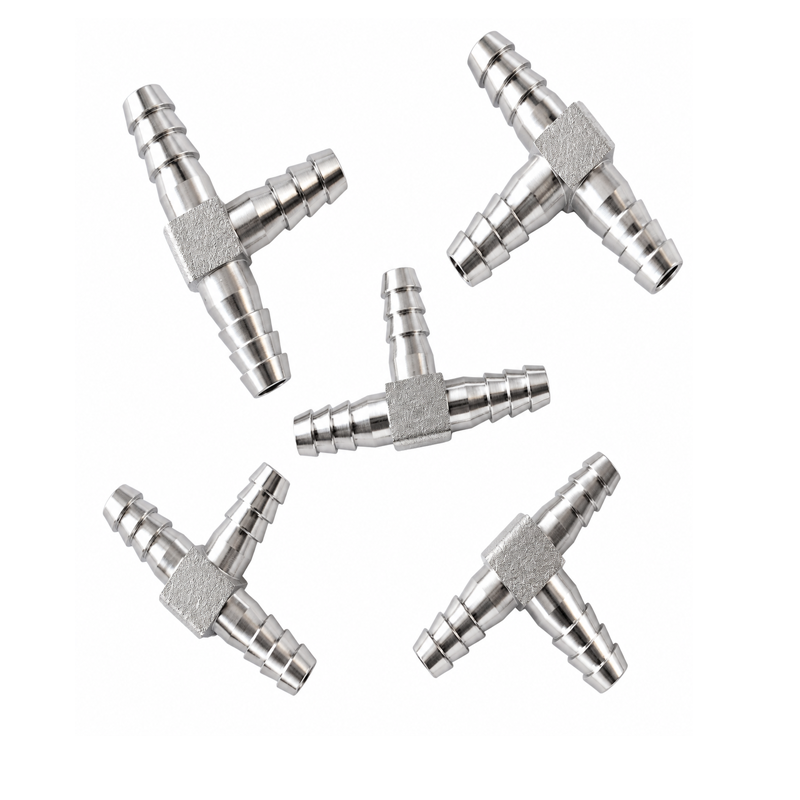
Stainless Steel Precision Turned Components
View details →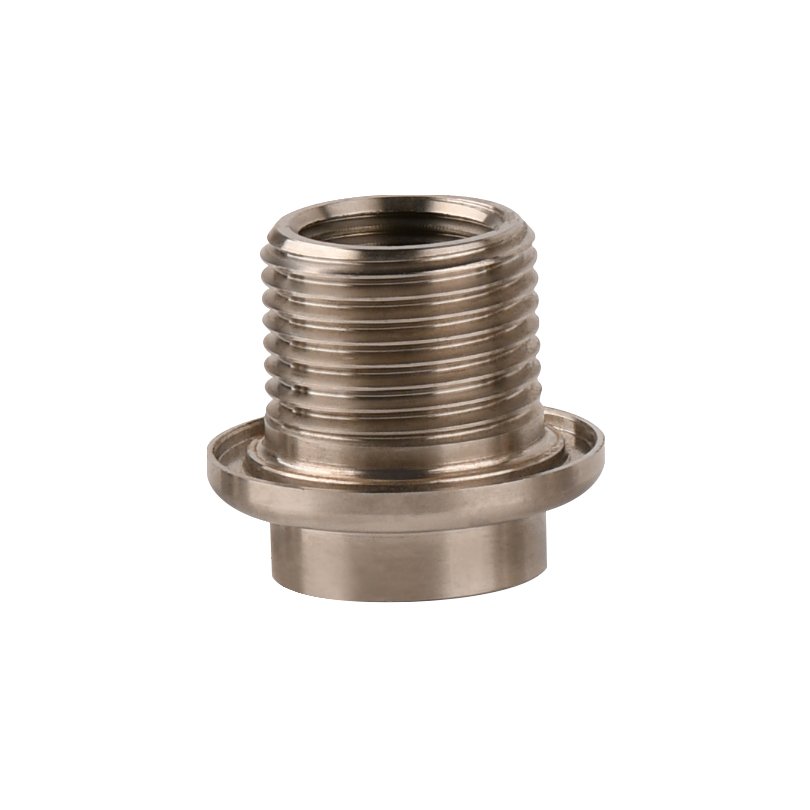
SS 316L CNC Machined Stainless Steel Fittings Supplier
View details →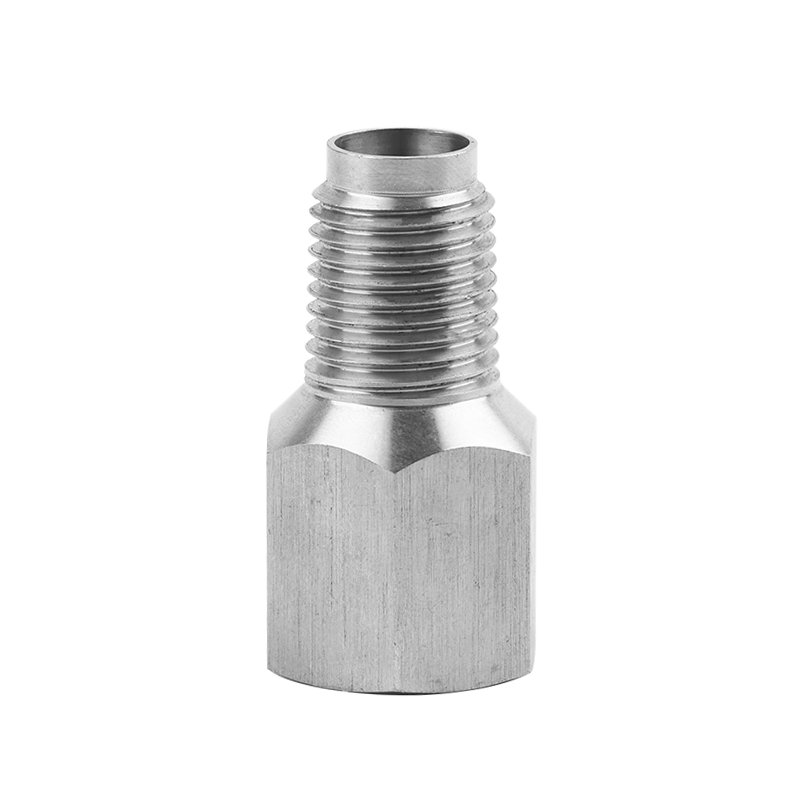
CNC machining services for NPT stainless pipe fittings
View details →
Custom 304 Stainless Steel CNC Machined Pipe Fitting
View details →
OEM Precision Custom CNC Parts and SS 304 Pipe Fittings
View details →
Custom cnc machining service for 316 ss fittings
View details →
Stainless metal pipe fittings
View details →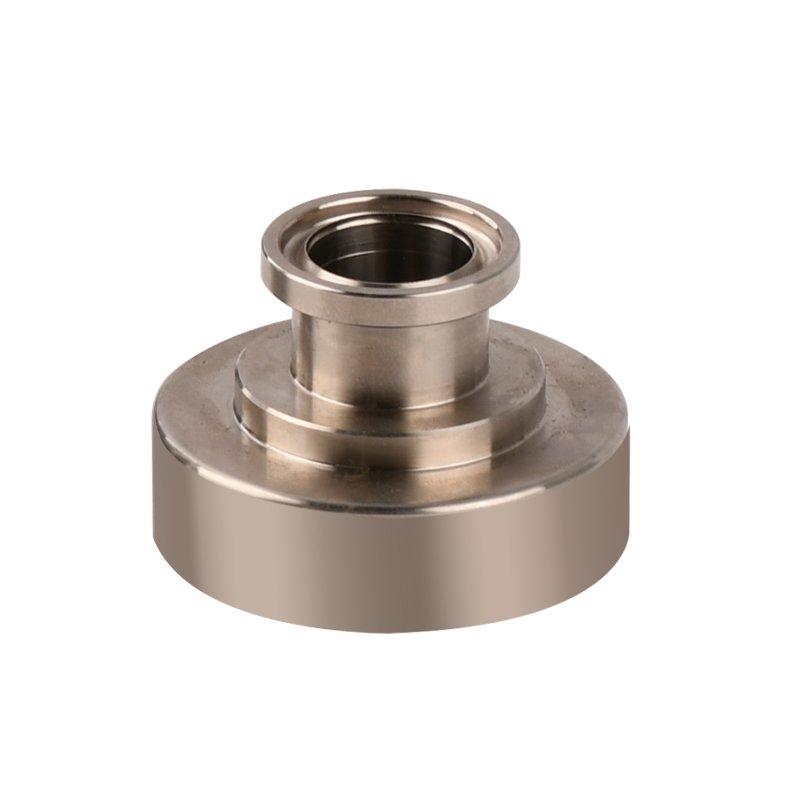
Custom CNC Turned Parts
View details →Send an inquiry to our team
Tell us material, thread, quantity, and requirements. After submit, email drawings to info@sspipefitting.com if needed.
Custom Stainless Steel Quick Connect Fittings